

Are you struggling to beat procrastination and properly manage your day-to-day schedule? Time management is one of the most important skills to have if you want to improve not only your work life but the quality of your life overall. There are numerous ways to do this, from prioritizing tasks, setting realistic goals, avoiding multitasking, all the way to just learning how to say no! In this article, learn about effective time management strategies. Not only will they improve productivity, they’ll also help reduce stress and foster a better work/life balance.
What’s Time Management?
Simply put, time management is the process of regaining control over how you spend your time. Doing so helps you maximize efficiency throughout all aspects of your life and helps you achieve any goal you’re trying to reach.
Related: Read up on our Professional Skills Development services
Why’s It Important?
The importance of time management lies in the fact that time is a finite resource. You’ve probably heard of sayings like, You only live once, or, The early bird catches the worm. While somewhat trite, these speak to the importance of time because the reality is you only get so much of it. More than that, it’s up to you to determine how to use your time.
Therefore, by understanding how to properly manage your time, you’re increasing your chances of prioritizing tasks, reducing stress, and achieving a balanced and productive life.
A Closer Look: Time Management in the Workplace
When considering the importance of time management through the lens of the workplace, the importance only increases. This is due to the realities of having a job that include working with others, meeting client demands and deadlines, and all the other variables that affect day-to-day workplace operations.
Given these factors, it shouldn’t come as a surprise that, according to TimeWatch, 94% say better time management will lead to increased productivity, 91% say better time management will lead to reduced stress at work, and 90% say it will lead to improved focus on tasks!

Key Benefits of Effective Time Management Strategies
While we touched upon a few benefits of time management in the previous section, let’s take another look at what happens when you better manage your time.
Improved Productivity
One of the most obvious benefits of time management is how much it helps improve productivity. In a way this needs no explanation: with better time management skills, you have a better grasp of what you need to do and therefore, you get more done.
However, the benefits of productivity go far beyond simply getting things done. According to Timeular, businesses that encourage employees to track their time more effectively can see revenue increases of up to 61%!
Reduce Stress & Prevent Burnout
Whether you’re an office worker dealing with unexpected changes in client demands or a manager struggling to juggle the mountain of tasks at hand, a lot of the mental issues we face in the workforce can be traced back to a lack of proper time management.
It’s not difficult to understand why. After all, if you haven’t properly planned and controlled how you spend your time, you’ll never feel like you have any authority over your days, weeks, and months. This can easily result in feelings of stress and burnout.
A Better Work-Life Balance
A common issue I see all too often in response to improving time management is the idea of, just do more. It’s the hustle culture mantra that promotes maximum effort which, despite its positive intentions, does more harm than good.
Time management doesn’t mean waking up at 5 am and going to sleep at midnight so you have more time to do more. This only leads to burnout. Proper time management means understanding what you can and can’t do in a given time frame to maximize your satisfaction both in the workplace and in life.
Want to simplify problem solving in the workplace? Read up on this post about Lego Serious Play
What Happens Without Proper Time Management Skills?
In a way, without proper time management, the flip side of what we mentioned in the previous section happens. However, let’s take a closer look at the problems at hand.
Less Productivity, More Procrastination
As per a study by Darius Foroux of over 2,000+ people, 88% of the participants admitted they procrastinated for at least 1 hour while at work. While 1-hour isn’t that large in the grand scheme of things, in the course of a 9 to 5 workday, it’s a decent amount.
If you look at a broader sample size of participants, you’ll find the rates of procrastination higher than 1-hour. This is due to the number of distractions like social media available today–Procrastination is more common than not and without time management, it’s easy to fall into its trap.
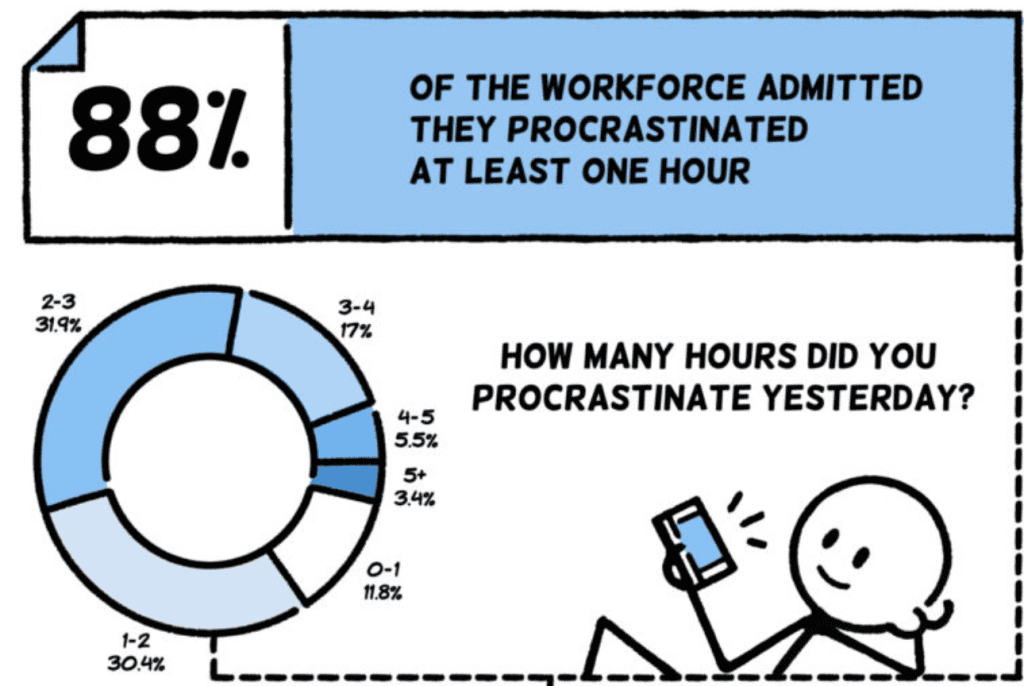
How much are people procrastinating? Image by Darius Foroux
Professional & Personal Relationships Suffer
As a result of the inability to manage your time, tasks pile up, deadlines are missed, and stress increases. Once you’re in such a cycle, the quality of your work will begin to suffer, and ultimately, your professional and personal relationships will take a hit.
While this might seem like an exaggeration of what can happen with poor time management, the reality is that being able to effectively manage time is a foundational skill from which numerous aspects of your life follow suit. Without a proper foundation, the rest crumbles.
A Negative Impact On Mental Health
Tying into the previous issue, poor time management can even go so far as affecting your mental health. Just imagine, you’re not managing your time at work or at home, and as a result, you’re dealing with a variety of problems that you have no one but yourself to blame.
How would you feel? If I were to hazard a guess you’re probably feeling unconfident, stressed, and overwhelmed. Again, this is a vicious cycle that needs to be addressed immediately.
6 Tips To Help You Become Better At Time Management
Prioritize Tasks
One great but often underutilized way to become better at time management is to learn how to prioritize tasks. When talking about prioritization in relation to time management, one of the best tools you can use is what’s called the Eisenhower Matrix.
The Matrix works by separating your tasks into 4 quadrants.
- Start with ‘Do First’ tasks. These are important and need to be finished on the same day.
- Second comes ‘Schedule’ tasks, those that are important but not as urgent. Schedule them for later.
- Third are ‘Delegate’ tasks, those that are urgent but less important, so they should be delegated.
- Finally, ‘Don’t Do’ tasks. These are neither urgent nor important. They should be forgotten.
According to Acuity Training, 50% of respondents that use the Eisenhower Matrix feel their work is under control every single day!
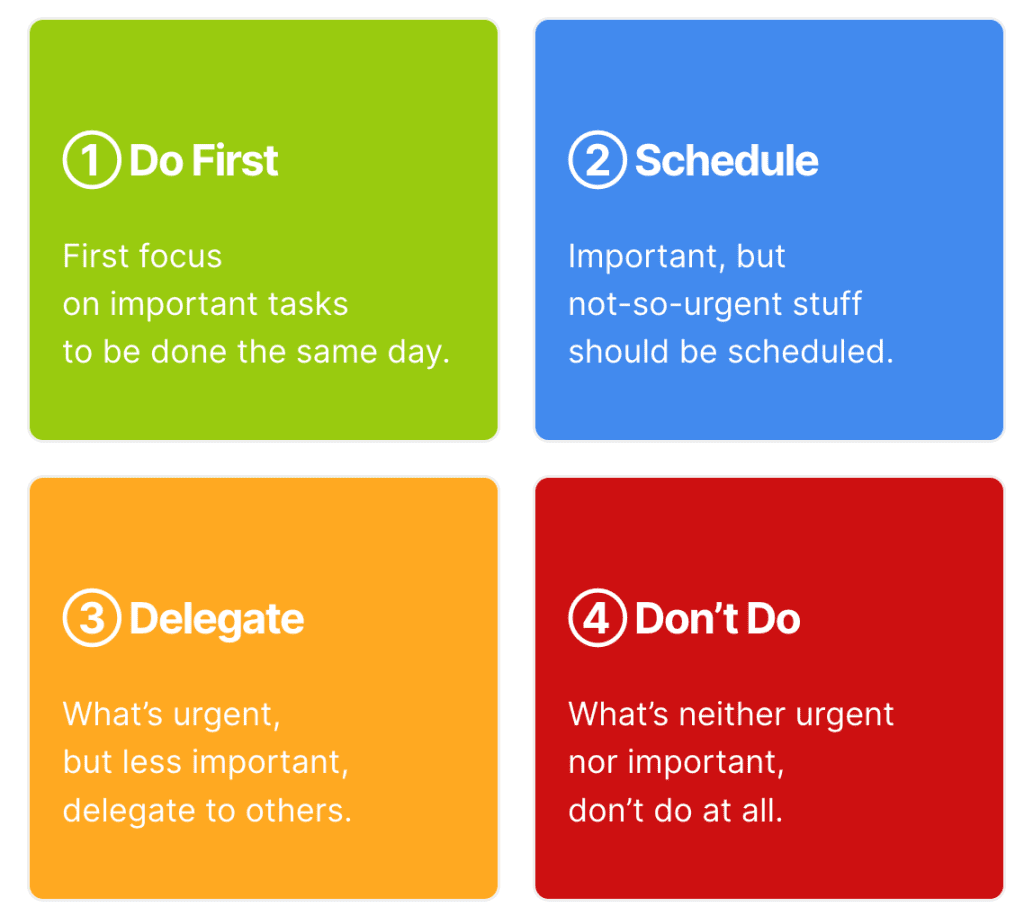
A visual representation of the Eisenhower Matrix from Eisenhower
Set Realistic Goals
Another key aspect of time management is the ability to set realistic goals. This is a simple, yet often overlooked strategy with severe ramifications when not done properly.
The reality is, a lot of the issues that arise with improper time management come when you set unrealistic goals. An example would be a goal that requires a week to complete but you only set aside two days. Already you’re putting yourself in a bad spot. The solution? Break projects into smaller steps, that way you get a clearer idea of how to tackle said project.
Avoid Multitasking
While some individuals claim they multitask well and wear that like a badge of honor, the truth is you should avoid it at all costs. For one, while many believe multitasking to be the act of doing multiple things at once, it’s actually more like flitting between multiple activities at once. This results in lower quality output in any one of those tasks because you’re not properly engaged.
Research on What To Become has also shown that multitasking decreases individual performance by 15% and organizations are 27.5% less productive because of employee multitasking. While some might feel pressured to multitask when faced with a mound of work, with proper time management strategies, you won’t have to.
Time Blocking For Productivity
Time blocking is a popular time management strategy where you structure your day into ‘blocks’. Each block constitutes a different task or group of tasks. Let’s say 9am to 10am is for emails, 10am to 12pm for meetings, and so on.
Time blocking is so effective because it allows you to take back control of your schedule as opposed to working in a reactive, randomized approach. Even better is when time blocking is used in tandem with a tool like the Eisenhower Matrix.
Whatever you choose to do, it’s important to remember that you need to block your day fully with tasks. This ensures you’re filling it up with things you want to do, instead of having your schedule swayed by external forces.
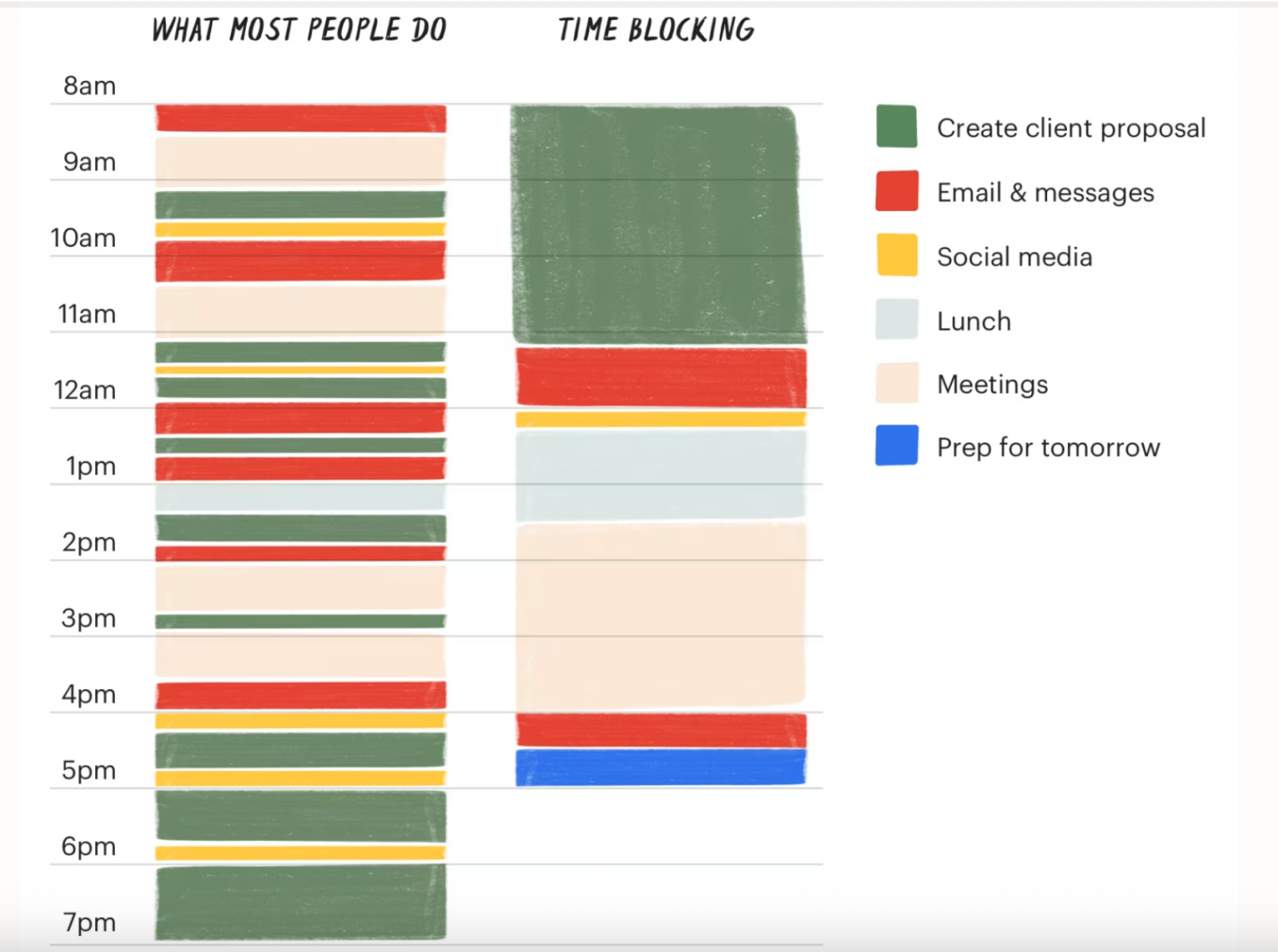
A visual representation of Time Blocking from Todoist
Say No (Learn To Protect Your Time)
Learning how to say no is as beneficial to your time management as it is to all other aspects of your life. One of the main problems people with ‘poor’ time management skills face is the fact that they’re often juggling way too many tasks at once.
By knowing how to say no, you can ask to delay certain projects when too much is being asked of you. A certain finesse comes about with this skill, but having the understanding and confidence to say no will greatly benefit a variety of aspects of your life.
Learn From Time Management Experts
As will all things, there are always experts in the field. In the field of time management, these names spring to mind:
- David Allen
Known as the father of time management, Allen created Getting Things Done, a productivity methodology that redefines how you approach life and work.
- Nir Ayal
An author, consultant, and teacher. One of Ayal’s books, Indistractible delves into learning how to control your attention.
- Tim Ferriss
Author of 5 NY Times Best Sellers and host of the The Tim Ferriss Show, Ferriss has a lot of books and videos available that can help you figure out how to better manage your time.
- Cal Newport
Computer scientist and bestselling author, Newport has written books like Deep Work, Digital Minimalism, and Slow Productivity.
How Do You Apply Time Management Skills In Real Life?
- Start by identifying your biggest time-wasting activities and figure out how you can replace those with more productive habits. It’s important to remember to set realistic goals, as well as to utilize tools like the Eisenhower Matrix and Time Blocking to help you out.
- Once you identify areas of improvement, use planners or apps to outline your daily schedule moving forward. Make sure you commit to ending each day by reviewing your accomplishments, before planning for the next day.
- Understand that building good habits takes time. Consistency is key but it’s also important to figure out what works best for you. That’s why you should try out different management techniques one at a time and choose what works best for you.
A Look At Effective Time Management Tools
| Tools | Uses |
| Trello | Visualizing workflows, planning projects, and collaborating on group tasks. |
| Asana | Managing complex projects, delegating tasks, and ensuring deadlines are met. |
| Google Calendar | Blocking time for work, setting reminders, and coordinating meetings with others. |
| Pomodone | Breaking work into focused 25-minute intervals with short breaks in between. |
These are by no means the extent of the tools that can help. Again, finding what works for you is key to consistent, effective time management.
How Did I Begin To Improve My Time Management?
Speaking on my personal journey of improving my time management, I began by recognizing the impact of procrastination on my productivity and stress levels. Small changes like setting daily priorities and using digital tools for tracking tasks came first.
This involved using my calendar much more clearly, color-coding different sorts of tasks, and planning chunks of time to keep track of what I should do and actually did. Combining this with my notes to track meetings and creating task lists that I would import into my calendar meant I knew what specifically I had to do at what time. Over time, systems that aligned with my work style and personal goals were built.
How Can I Help?
With 20 years experience, including impactful roles at Google and Apple, I, Thijs van Loon, am here to help. My suite of services as a Skills Development Facilitator has been meticulously designed to propel your team to new heights.
One area of expertise is in Professional Skills Development, which can cover anything from sales training, team management, and time management.
By leveraging training certifications from Google and Apple, in addition to my certifications in NLP, Psych-K, DISC Flow, and LEGO© Serious Play©, I offer tailored, practical solutions that deliver immediate results to your business. By working together, I can help you empower the individuals in your company and your business at large, whether in Vietnam, Singapore or other locations in Southeast Asia.