
Imagine you’ve got an upcoming negotiation with a client from overseas. You’re going to negotiate an upcoming contract which could have the potential to take your business to the next level but the only problem is, you’re not entirely sure what your negotiation counterpart is like.
In such a scenario, have you ever considered the helping hand of Artificial Intelligence (AI)? There’s so much you can do with AI and yet one area it often gets overlooked is with negotiations. Besides being one of the best ways to prepare for negotiations, AI can also serve as a real-time partner for practicing and improving negotiation skills, as well as receiving feedback at the end of a negotiation.
Key Takeaways
- AI can transform your negotiation preparation through three core functions: research assistance before a negotiation, scenario planning to anticipate different conversation paths, and a sparring partner to build confidence. However, it’s important to remember AI cannot predict individual behavior or replace genuine relationship-building.
- Most effective approach: Use AI for 20-30 minutes of pre-negotiation preparation, focusing on professional contexts rather than personal characteristics. Combine AI insights with your own research and judgment for best results.
What Does It Mean To Be Prepared For A Negotiation?
The importance of preparation in negotiations cannot be overstated. But what does it even mean to be prepared for a negotiation?
In essence, negotiation preparation refers to having the ability to deal with as many, if not every, angle that a conversation can take during a negotiation. These angles can be as large as being prepared for how cultural backgrounds affect negotiations to anything as small as understanding the individual characteristics of the person you might end up negotiating with. Here are a few other questions you should be asking yourself about the person you are about to negotiate with, before a negotiation in order to ensure you are adequately prepared.
| Are they risk takers or risk averse? | Are they analytical or more intuitive? |
|---|---|
| Are they competitive or collaborative? | Are they talkers or listeners? |
| How do they react to conflicting opinions? | How slow/fast is their decision making pace? |
| How formally/informally do they prefer to communicate? | How directly/indirectly do they communicate? |
→ While you might be wondering how to answer these questions, you needn’t worry, this is where AI comes in handy! Later on in this article I will outline how you can use AI to help answer these questions.
If you’re able to answer these questions at the start, you can get a better idea of the assumptions you have going into a negotiation. From there, it’s possible to test these assumptions to get a more holistic view of your whole negotiation mindset and strategy.
Related: Read up on our Professional Skills Development services

Why Is It Important To Be Prepared For A Negotiation?
According to statistics published on Zipdo, 70% of negotiators believe that preparing thoroughly is the key to success. Despite such numbers, the alarming reality is that 65% of employees report feeling unprepared for negotiations, as per stats published by WorldMetrics.
This is why no matter what your desired outcome is for a negotiation, it’s always important to remember that step one should focus on preparation. Once you get to a point where you’re comfortable in these situations, you can reach what the late Jim Camp (author of “Start with NO!”, often referred to as the world’s most feared negotiator), called blank slating. At this point you stop having any expectations for or during a negotiation, meaning you’re never emotionally or mentally rattled by the course a negotiation may take.
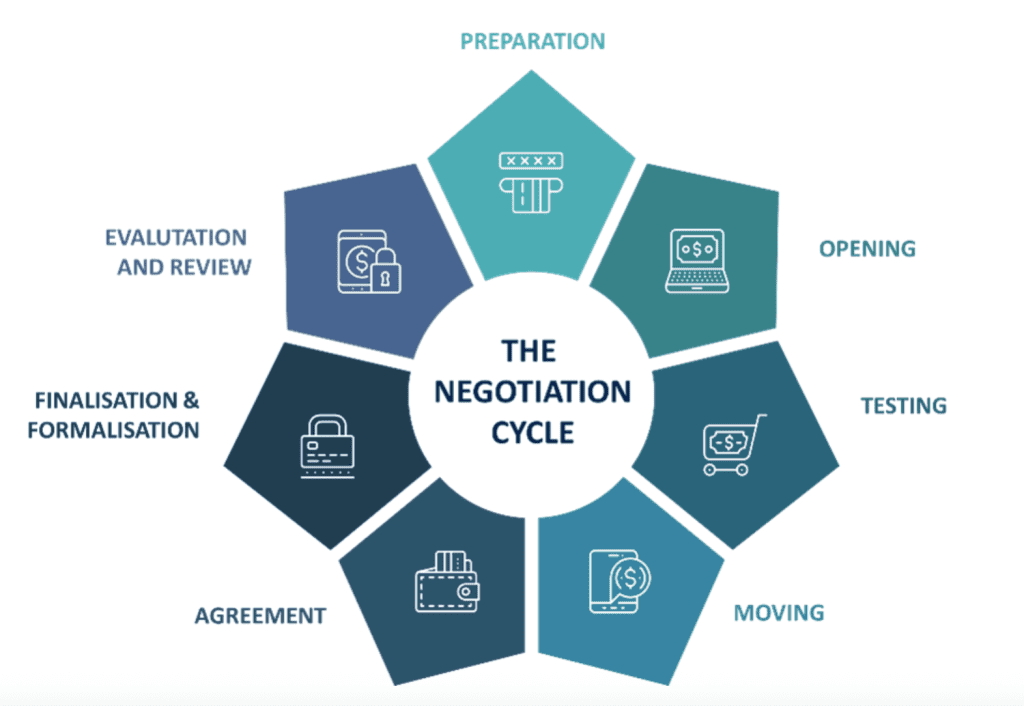
Image courtesy of SRStrategic Sourcing
The Role Of Practice In Negotiations
Practicing for a negotiation tends to involve much more hands-on, real-time activities that can get you ready for a negotiation. Think role-playing and similar scenarios that can give you an idea of how an actual negotiation might unfold. Within role-playing, you can practice how to open, how to counter, how to listen, as well as familiarize yourself with tactics like anchoring and the various cultural and personality types you might come across while negotiating.
Take for example the sales teams at P&G. They actually roleplay their negotiations internally before going out and working with their clients. This is not done by a lot of people given how much time and effort it takes. However, the juice is worth the squeeze and better yet, with AI, now this process is simplified!
What Role Does AI Play In Negotiation Preparation & Practice?
Modern AI can act as a real-time sparring partner for improving your negotiation skills. Here’s how to set up effective practice sessions that mirror real negotiation dynamics.
AI Practice Session Setup Guide (for ChatGPT)
| Step | Action | Example Setup | Pro Tips |
|---|---|---|---|
| 1. Choose Mode | Start ChatGPT in Voice mode | Enable voice for natural conversation flow | Voice mode creates more realistic practice than text |
| 2. Define AI Role | Give AI specific character details | “You’re the procurement manager at TechCorp. You’re analytical, budget-conscious, and prefer detailed proposals.” | Include communication style: direct, collaborative, formal, etc. |
| 3. Set Context | Provide negotiation background | “We’re discussing a $50K software contract. Main concerns are implementation time and ongoing support costs.” | More context = more realistic responses |
| 4. Practice Session | Negotiate for 5-10 minutes | Use real talking points, handle objections, practice your key messages | Treat it like the real thing |
| 5. Get Feedback | Request immediate analysis | “Stop the role-play. How did I do? What should I improve?” | Ask for specific, actionable feedback |
| 6. Reverse Perspective | Get counterpart insights | “Give me 3 tips from my negotiation partner’s viewpoint. Start with what would get the fastest results.” | Understanding their perspective improves your approach |
Practice Scenario Examples
| Negotiation Type | AI Character Setup | Key Focus Areas |
|---|---|---|
| Salary Discussion | “You’re my direct manager, supportive but budget-conscious” | Timing, evidence presentation, alternative compensation |
| Vendor Contract | “You’re a vendor sales rep, experienced and persistent” | Price negotiation, terms, service levels |
| Client Agreement | “You’re a client stakeholder, detail-oriented and risk-averse” | Scope definition, timeline, deliverables |
The key is treating AI practice sessions seriously—the more realistic you make the setup, the better prepared you’ll be for actual negotiations.
Having said that, it’s important to remember to use AI in conjunction with your own research. AI is great at providing quick answers to any questions you might have, but to ensure maximum preparation, conducting further research to ensure accuracy is needed.
How AI Benefits Negotiation Practice
Moving on, let’s consider how AI benefits negotiation practice. Given AI’s current language models—which are constantly improving—AI can act as something of a sparring partner designed to test you on your negotiation skills.
Even better is the fact that by providing an AI tool with a set of prompts, you’re able to tailor it to meet your specific needs and requirements. For example, let’s say you’re preparing for a negotiation with someone from a company based in the US, where communication is much more blunt and direct than Vietnam. You can actually prompt your AI agent to interact and react to you according to such cultural nuances, thereby providing you with an idea of what you can expect when it comes time to actually negotiate.
How Can AI Help You Identify Your Personal Strengths & Weaknesses In Negotiation?
There are numerous ways in which AI can help you identify your strengths and weaknesses. In the previous section I outlined how AI benefits negotiation practice by serving as a sparring partner. This alone helps you gauge where you stand in certain negotiating settings. Using the same example of getting ready for negotiations with someone from a company based in the US, AI can provide feedback on how well you did during that negotiation, thereby identifying your strengths and areas for improvement.
This is something I do myself whenever I’m preparing for a negotiation. Framing the AI agent with a set of specific instructions ensures that it’s getting the requisite information which will later be used to determine your strengths and weaknesses.
→ Beyond that, here are some other things AI can tell you:
| Word choice (pointing out the effect of the words you use) | Tone (pointing out how you sound based on your word choice) | Framing (pointing out how you come across based on word choice and other cues) |
|---|---|---|
| Pace (pointing out how quickly/slowly you speak, what effect that has) | Hesitation (pointing out any language or phrasing that signals uncertainty) | Clarity (pointing out how clearly you speak, frame, counter during negotiations) |
| Pattern recognition (pointing out repetition, as well as things you do well and things you need to improve on) | Benchmarking (pointing out where you stand against industry standards or peer groups) | Performance tracking (pointing out skill development over time, what areas need focused practice for improvement) |
Beyond this, whenever I teach negotiation skills, I always begin by getting participants to take a test such as the one found on The Black Swan Group which tells you what type of negotiator you are. From there, it’s possible to leverage AI to prepare and practice for negotiations, all the while developing said skills.
The 3 Ways AI Helps With Boosting Negotiation Skills
Preparing For Negotiations
To begin with, I use AI to prepare for negotiations just so I have a cheat sheet or blueprint for when they actually start. As stated, with the current AI models and the fact that they are constantly improving, gathering all the necessary information has never been easier.
Leveraging AI for preparations will streamline the process and make it that much simpler. However, it’s important to remember to use AI as a tool, not as your sole resource.
Practicing For Negotiations
Modern AI boasts the ability to act as a real-time sparring partner for improving your negotiation skills. The options for how AI can help here are endless, which is why whenever I run negotiation skills training sessions, I always use AI tools for training and coaching.
Essentially, what I do is provide AI with a case study that it will use to let trainees practice. Trainees are given a number of opportunities to provide questions, summaries, and other inputs taught during workshops before AI will test them on how well they’re applying what they’ve learned. Here’s a step-by-step guide on what this looks like.
- Start your ChatGPT and use “Voice mode”.
- Tell your AI agent what its role should be. For example: “You are my client who I need to negotiate a deal with.” Don’t forget to provide the specifics (client role and company, what you discussed so far, typical sticking points) → You can even ask them to be tough or mild, depending on what you have seen your counterpart do in previous negotiations.
- After practicing a few minutes, ask them for feedback by saying, “Stop the conversation now. Can you share how I did? What things can I improve?”
- Finish with: “Give me the top-3 tips to go into my next conversation if you looked at this negotiation from my counterpart’s point of view. Start with the point that would likely bring the best or fastest result.”
Feedback From Negotiations
The power of AI doesn’t end there. From filling in what I learned after a negotiation, recording observations from the various parts and people in the negotiation, to providing feedback on the steps moving forward, AI doesn’t stop helping until after the deal is closed. The value of this is undeniable, given that 83% of employees say they appreciate feedback, whether it’s positive or negative, as per a study on PeacefulLeadersAcademy. All in all, this makes AI a 3-step partner during the negotiation process, ensuring you have something to rely on every step of the way.
Interested in finding out more about negotiation? Read up on What’s Culture’s Role in Negotiation?
How Should You Start Integrating AI To Improve Negotiation Skills?
While you have an understanding of why I use AI for improving negotiation skills, let’s now take a look at how I begin to do this. Let’s consider using AI for negotiation preparation and feedback.
How To Integrate AI For Negotiation Preparation
I usually start by asking my AI to create a purpose or goal for the meeting I’m about to go into. This will usually be focused on the highest, most optimistic goal I hope to achieve, or the Best Alternative to a Negotiation Agreement (BATNA), which is essentially something of a backup plan. Besides those, I also use AI to figure out what the minimum goal is, basically, at what point I should walk away.
From there, AI can suggest questions I can use during the negotiation. Chris Voss, a former FBI hostage negotiator, calls these ‘calibrated questions’. These will help in guiding the negotiating in the right direction. Voss also suggests a number of ‘labels’, or, ‘cold reads’ to be aware of. Examples of this are phrases like: “It looks like you want to avoid unnecessary risks” or “It seems like you value quick implementation”. These provide insight into what your negotiation counterpart values.
Lastly, AI can also provide background information on the people in the negotiation, which allows you to be that much more informed during a meeting.
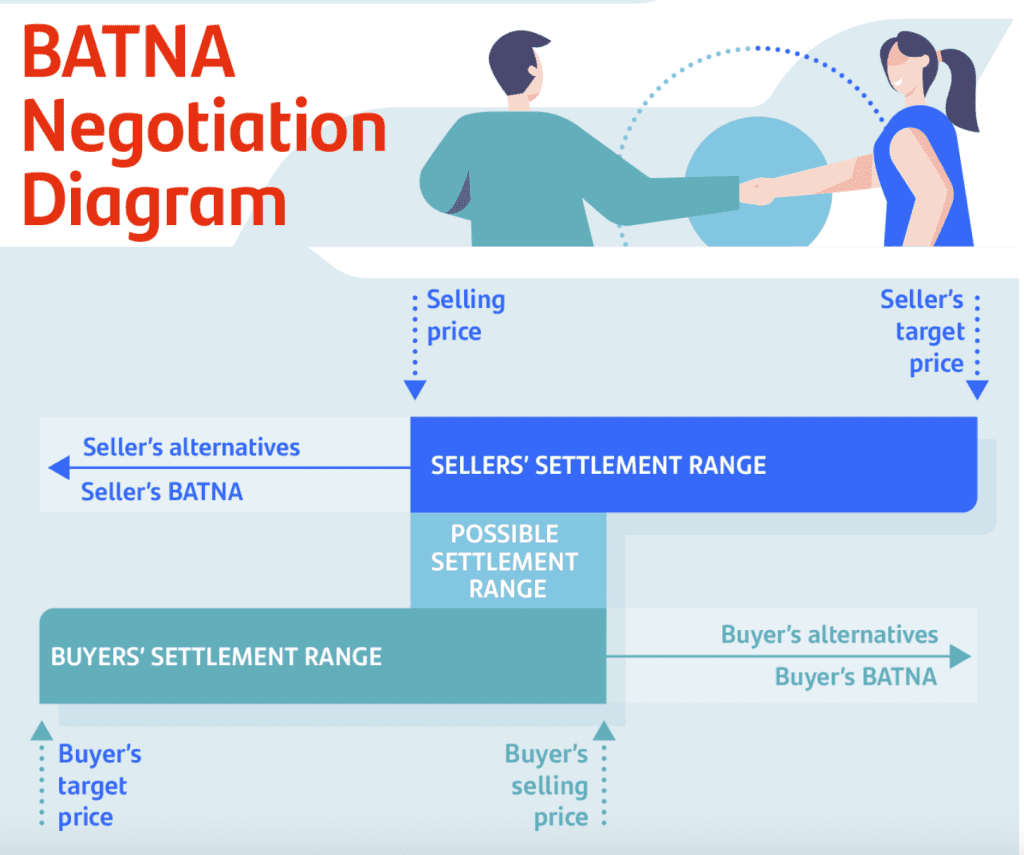
Image courtesy of Santander Open Academy
How To Integrate AI For Negotiation Feedback
After a negotiation is finished, I always consult my AI agent to fill in any blanks regarding what happened, what I did well, what went wrong, and what I could improve on. More so than this, AI is great at checking for assumptions and asking me “who said what”. This allows me to tie people’s remarks to their role and through that, build a deeper understanding of their vision or impression of the overall negotiation. By connecting all these elements, AI provides me with a summary, which can later on be used to prep for the next conversation.
What Does The Future Of AI In Negotiation Look Like?
By using AI the right way, in a manner that treats it as a useful tool and not as the be-all-end-all of your negotiation training and learning, you can see significant improvement in your negotiations.
While some people might look forward to a future in which AI can do the negotiating for us, I remain skeptical that it can completely take over in this aspect. For one, to successfully negotiate on our part, AI agents will need to know exactly what you want, all the while dealing with the specific subtleties that a negotiation brings.
Besides that, communication between humans is a unique, special means of connection that I currently believe AI cannot get in between. Even if one day the technology advances to such a point where machines can do this for us, I am of the firm belief that negotiations between humans are vital because it’s necessary to interact and build relationships with the people you negotiate with. Ultimately, having that desire is the best way to succeed in any interaction, negotiation or not.
What Should You Do Next?
Despite all the details I’ve provided in this post about boosting your negotiation skills with AI, there’s a chance that at some point you’re going to get stuck figuring out how to move forward.
With over 20 years experience as a Skills Development Facilitator and roles in Google, Apple, and beyond, I’d love to help you out with any issues you might face along your journey of improvement. So if you’re trying one of my solutions but find yourself stuck, don’t hesitate to contact me here—I’d be more than happy to help!