

Understanding the role culture plays in negotiation is paramount if you are to become an effective negotiator. More than anything, culture serves as a great way of understanding the context and expectation behind which a negotiation takes place, thereby providing you with a roadmap moving into a particular situation. Once you grasp this concept, you’ll be that much more prepared to tackle cross-cultural negotiations, making you that much more of a global force in the workplace.
Why Should You Care About Improving Your Cross-Cultural Negotiation Skills?
Before diving deeper into the nuances of cross cultural negotiation, you might even be wondering why you should care? Here are two statistics that might convince you of their importance.
- As per Red Bear Negotiation, 72.7% of business professionals report a significant increase in cross-cultural negotiations over the past three years (as of 2024). This emphasizes the growing need for cultural agility in business interactions.
- According to Procurement Tactics, poor negotiation skills can lead to a 5% loss in profits, while effective negotiation strategies have the potential to improve profits by up to 50%.
How Does Understanding Culture (And Communication) Affect Negotiations?
As stated, culture serves as an effective means of understanding the context and expectation behind a negotiation. What this means is that when you understand the nuances of a specific culture, it’s possible to figure out the best course of action when negotiating with someone with those characteristics.
This is why in many ways, though it’s useful to understand culture, what you’re actually trying to do is figure out how to best communicate with another person. After all, negotiations are a process by which two or more parties communicate to resolve differences and reach a mutually acceptable agreement. When you know how to properly communicate, cultural factors play less of a role.
Related: Read up on our Professional Skills Development services

How Do The Trajectories of Negotiation Differ Based on Culture?
Taking British linguist Richard D Lewis’ insights into cultural communication patterns and how these affect the trajectory of negotiations, the World Economic Forum published a series of charts depicting the differences between countries. Let’s use the United States and Singapore as examples and consider how to approach negotiating based on their charts.
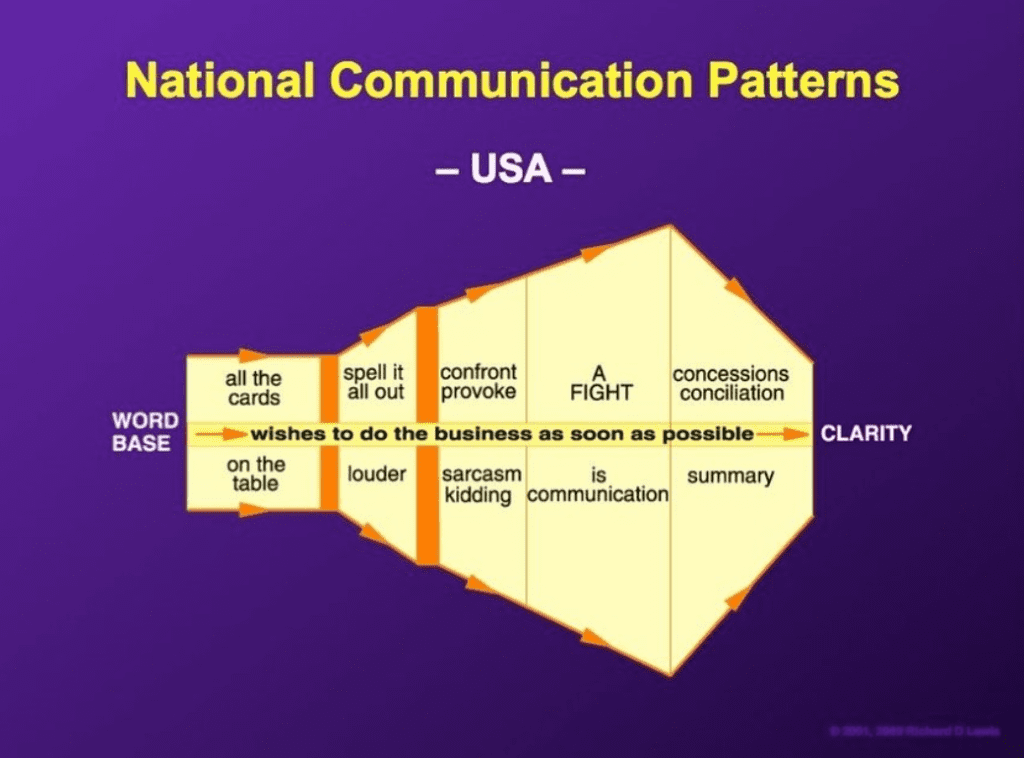
Image per World Economic Forum
As one might expect, negotiations in the US tend to operate on a much more direct and resolution-centric approach. The aim is to get an optimal deal agreed upon in as little time as possible, and ‘fighting’ is oftentimes considered a necessary means of communication. By understanding that this is normal and to be expected, it’s possible to negotiate much more effectively under these circumstances.
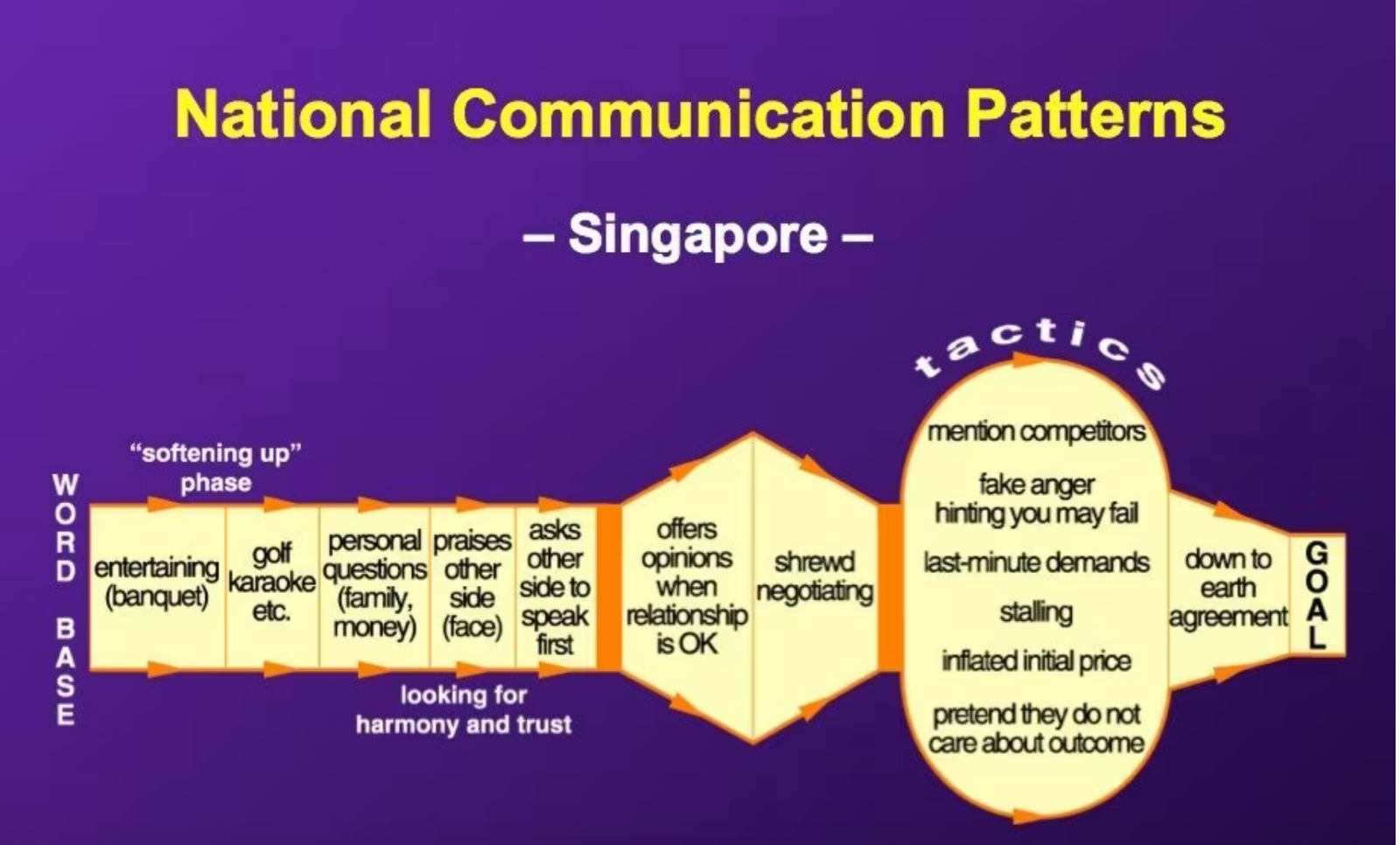
Image per World Economic Forum
On the other hand, negotiations in Singapore take a much more slow and measured approach. Beginning with a softening up phase, the aim here is to find harmony and trust with the person on the other side of the table. Once a relationship is built, negotiation tactics can become shrewd, but the final agreement always emphasizes a spirit of unity.
→ These are but two examples provided on how negotiations differ based on culture. As stated, with a deep understanding of communication, you’re better equipped to deal with these differences. However, this doesn’t mean you need to adopt communication styles from other regions. Let’s find out more in the following section.
How about workplace motivation? Learn 6 Essential Strategies for Workplace Motivation
How Is Authenticity One Of The Most Underappreciated Negotiation Skills?
Ultimately, negotiation is done by influencing the person on the other side of the table. While, as we’ve discussed, culture plays a role in providing a way to understand the context and expectation behind a negotiation, as well as give insight into common negotiation trajectories, remaining authentic is also key. Before we get into the importance of authenticity, it’s helpful to grasp the differences between direct and indirect communications styles.
| Direct | Indirect | |
| Definition | Speaker is expected to be clear, specific, and straightforward. | Speaker is expected to be more measured, taking into account the other person and allowing for ‘saving face’. This means to never publicly criticize in a way that damages an individual’s reputation. |
| Characteristics | Assertive, aggressive, forthright. | Subtle, nuanced, indirect. |
| Perception of Other | Direct communicators can sometimes find indirect communicators evasive and slow. | Indirect communications can sometimes find direct communicators aggressive and demanding. |
How Do You Remain Authentic When Negotiating?
According to Erin Meyer, author of “The Culture Map” and someone who has done 20+ years of research on culture from some of the leading business schools in the world, there are a number of ways to remain authentic when negotiating. For starters, it’s useful to recognize differences between cultures. Some are more confrontational than others. Some build relationships based on trust and time instead of how many tasks they might complete together. Understanding such differences is helpful.
However, more so than that, while it’s common to believe that the best way to negotiate with someone outside your culture is to adopt their cultural and communication style, the reality is, they’ll be able to smell the inauthenticity from a mile off. This will hinder negotiations as you can come across as dishonest and disingenuous.
What’s better is to understand cultural dynamics and their varying communication styles. This ensures you’re well-prepared for communicating across cultures as you have an idea of what to expect in such situations.
What 3 Questions Should You Ask To Remain Authentic During Negotiations?
Here are three questions that can help you remain authentic when negotiating across cultures.
- How does a culture form and convey a viewpoint?
- How does a culture form and convey a vision?
- How does a culture suggest a mode of action?
Typically, cultures with indirect communication styles form viewpoints first. They do this by looking into the history of a topic or issue. After that, they form a vision of what needs to change. Finally, they provide a mode of action for doing so.
Contrary to this, direct communication styles start the other way around. First they state the mode of action that needs to occur. Afterwards—if there’s time—they get into why they formed this vision, as well as the history of that topic or issue.
→ A simple way to remember this is by looking at how names are formulated in different cultures. Asians, considered more indirect, start with their family name first. There’s an emphasis on environment, background, and history. Westerners, on the other hand, have their first name first, then last name. There’s an emphasis on the individual and freedom.
A Closer Look At Cross-Cultural Differences in Negotiations
According to World Metrics, cross-cultural negotiations are 20% more likely to succeed when parties use interpreters and cultural consultants. Having access to these individuals is great, but if you don’t, you can still increase your chances of negotiation success by taking a look at the table below. It summarizes key aspects of the differences between Eastern and Western negotiators.
| Aspect | Eastern Negotiators | Western Negotiators |
| Approach to Negotiations | Eastern negotiators have a much more slow-paced approach to negotiations, while putting an emphasis on relationship building. | Western negotiators have a much more direct, task-oriented and efficiency-driven approach to negotiations. |
| Decision Making | Group oriented and more consensus driven. | A top-down approach, individualistic and fast. |
| Communication Styles | Indirect communication is more common. Harmony and ‘saving face’ is prioritized. | Direct communication is much more common, and there’s not much concern with emotional restraint. |
| Contracts | Contracts are much more flexible. Building relationships and trusting someone can be seen as more important. | Contracts are much more binding. When it’s written on the dotted line, it’s set in stone. |
| Attitude to Conflict | Prefer to avoid conflict when all possible. | Conflict is more common, and can be seen as a necessary evil. |
| Perception of Status | Hierarchies and seniority are much more valued. | Less value on seniority. Negotiators may be considered equals. |
What Are The Pillars Upon Which Successful Negotiations Are Built?
Now that you have an understanding of the cross-cultural differences in negotiations, as well as the importance of communicating effectively when negotiating, let’s take a look at what separates successful negotiations from those that aren’t.
The Importance Of Respect
Without respect, negotiations will always conclude in a manner whereby both parties feel as if they’ve gotten the short end of the stick. After all, respect is the foundation upon which all human relationships should be based, so without it, negotiations will never go as smoothly as they could. It’s no wonder why the Negotiations Training Institute states that parties are more likely to make concessions and work toward shared outcomes when treated with respect.
→ Respect means understanding and accepting cultural and individual differences without trying to manipulate them to your advantage. Doing so allows for a negotiation whereby both parties are trying to get the best for themselves as well as the other.
The Importance Of Trust
Trust is another foundational pillar of negotiating. Without trust, you end up negotiating in a way where you’re driven by emotion and greed, two ways to guarantee a stressful, altogether unsuccessful negotiation.
→ Trust means being honest and genuine in how you approach a negotiation, with the understanding that by doing so, the person with whom you negotiate will reciprocate. Harvard PON recommends engaging in at least five minutes of small talk before a negotiation begins to develop trust. When engaging in this type of pre-negotiation talk, make sure that you’re not just doing it for the sake of it. They should be genuine as these conversations are worth their weight in gold.
The Importance Of Patience
Patience in negotiations tends to go overlooked because most parties have a desire to wrap up a deal and move on as quickly as possible. While getting negotiations over in as short a time as possible might seem appealing, taking time can reap more rewards.
→ Patience means negotiating in a way where no parties feel pressured into making a decision, as well as giving yourself the chance to walk away from the negotiation so as to provide the other party with the space to come to their conclusion. This is something that needs to be planned as part of your negotiation goal for this specific portion of the negotiation.
What Should You Focus On When Negotiating?
As per another statistic on World Metrics, over 50% of negotiations fail as a result of poor communication skills. This is why it’s imperative to treat the early to mid stages of negotiations not as a period of haggling and persuasion, but a time to gather information.
The reality is, every party comes into a negotiation with an agenda. This is why it’s important to slow down the whole process and spend some time figuring out what that agenda might be. When doing so, you should stick to the three pillars previously mentioned. Doing so ensures information gathering doesn’t take place in a hostile environment.
How Have You Helped HR Professionals Improve Their Negotiation Skills?
A few years ago, I ran a negotiation training with a large Vietnamese organization (I cannot share the name for privacy concerns).
- What was their problem?
They needed to renew all contracts with 2000+ suppliers.
- What was my solution?
I started by creating a workshop for all relationship managers. These are people who held relationships with the suppliers from this particular FMCG company. From there, I divided the groups based on how experienced they were at negotiating. In the workshop, we focused on developing tools to influence others effectively, as well as learned how to create relationships for the long term.
During the workshop I worked closely with the sales director and a consultant hired specifically for the task, ensuring there was a structure set for preparing the negotiation, and that people would actually practice in-house. This was key!
To ensure practice took place, I also ran train-the-trainer sessions for senior managers and directors so they could ensure continuous practice inside the organization.
- What happened?
After a few months, all contracts were renewed.
How Can I Help?
With 20 years experience, including impactful roles at Google and Apple, I, Thijs van Loon, am here to help. My suite of services as a Skills Development Facilitator has been meticulously designed to propel your team to new heights.
One area of expertise is in Professional Skills Development, which can cover anything from sales training, team management, and improving negotiation skills.
By leveraging training certifications from Google and Apple, in addition to my certifications in NLP, Psych-K, DISC Flow, and LEGO© Serious Play©, I offer tailored, practical solutions that deliver immediate results to your business. By working together, I can help you empower the individuals in your company and your business at large, whether in Vietnam, Singapore or other locations in Southeast Asia.