
Learning & Development (L&D) programs are an essential part of upskilling in the workplace, but the issue is, most of the programs used today fall short of delivering any real change. This is true whether you’re in Southeast Asia or abroad, with most L&D programs forgetting a key component in ensuring they benefit the organization, its employees, and its consumers. That idea can be summed up in a question, which is, how does an organization and its employees create value for those they serve? By answering this, it’s possible to begin building an L&D program that excels in areas such as skill building, knowledge enhancement, and employee engagement.
What’s A Learning & Development Program?
Though we introduced the idea, let’s gain a better understanding of L&D programs. Essentially, these programs are focused on improving the skills, knowledge, and competencies of employees within an organization.
The types of skills trained during these programs range across the board. According to stats published on Research, the skills considered the most important in today’s economy are Interpersonal Skills (85%), Written and Spoken Communication (85%), and Critical Thinking Skills (84%). These are among the many topics covered during L&D programs.
Related: Read up on our Professional Skills Development services
Why Are Learning & Development Programs Essential?
The primary goal of L&D programs is to enhance both individual performance and overall business outcomes through targeted training and development activities. This makes them essential because they provide a framework and process whereby employees and an organization can improve and provide better services to others.
The value of L&D programs are recognized globally. However, narrowing our scope to Southeast Asia, studies published on SME Horizon highlighted their especial importance after it was found that 77% professionals in Southeast Asia planned to upskill in 2023 vs 74% of professionals globally!
What Are The 5 Key Components Of A Successful Learning & Development Strategy?
1. Skill Building
Skill building refers to focused training sessions that improve more technical, job-specific skills, as well as more interpersonal skills such as leadership, communication, and teamwork.
Skill building is perhaps the most obvious component of L&D programs, with most organizations providing them as a means of helping their employees upskill. In terms of how skills are transferred, in-person L&D programs are common, but with the growing possibilities at the hands of digitization, Edtech is also booming. According to findings published on IMARC, the Southeast Asian Edtech market size reached $10.7 Billion in 2024. Looking forward, IMARC expects the market to reach $41.5 Billion by 2033, exhibiting a growth rate (CAGR) of 14.7%!
2. Knowledge Enhancement
Knowledge enhancement refers to the process by which employees in an organization can learn about industry trends, new technologies, and best practices to ensure they are creating the utmost value for their customers.
When it comes to knowledge enhancement, it’s important to emphasize an active learning approach. The learning retention pyramid is a great visual representation of what you should be emphasizing when learning. Ultimately, active learning methodologies are always better than passive types.
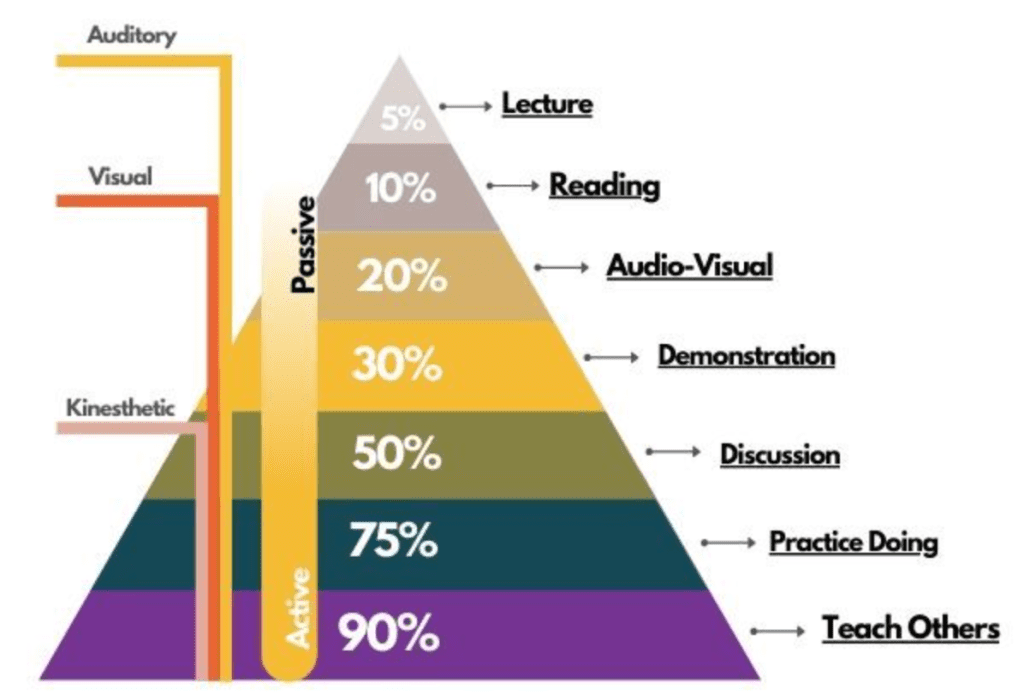
Image courtesy of Develop Good Habits
3. Career & Skills Development Over Time
L&D programs also open up pathways for career and skills development in the future. Oftentimes, without L&D programs, employees can feel as if they aren’t getting set up for long-term success. However, as a result of the mentoring and coaching initiatives that make up L&D programs, employees and managers feel as if they’re being taken care of. This is pivotal in boosting retention rates!
4. Employee Engagement
As stated, L&D programs open up pathways for career and skills development in the future. This directly ties into employee engagement as they feel as if their best interests are being taken into account. This serves to benefit both the employee and the organization. Workers will be more motivated, creative, and disciplined, creating a culture that’s marked by ongoing growth and success. On the other hand, companies with engaged employees reported 25% to 65% lower turnover rates than their less engaged counterparts, as per a study posted on Global HR Community.
5. Organizational Alignment
The final component to a successful learning & development strategy has to do with organizational alignment. This means ensuring that the core values and ethos of an individual company is understood by each and every employee. In other words, when you time L&D activities with a company’s overall strategies and goals, you provide individuals with the right skills at the right time. This allows them to reach their goals and reap the benefits of training.
What Steps Should HR Managers Follow To Build Effective L&D Programs?
In order to begin building an effective L&D program, we need to recall the key question first discussed in the introduction. That is, ‘How does an organization and its employees create value for those they serve?’. Using this question as a north star will prove to be the ultimate guide in building an effective L&D program. So, what’s next?
- Answer the question by figuring out the value that an organization and its employees create for their consumer. Values can range from functional, emotional, experiential, ethical, educational, social, or relational values.
- Once the value is highlighted, those values need to be translated into behaviors and skills that the organization and its employees can provide. This can involve asking further questions like, ‘What do people do to create this value?’ or, ‘What skills do they need (or need to enhance) to improve their value delivery?’.
- From there, you can create a capability framework or skills matrix for the different roles in the company. As a quick summary, a capability framework outlines the core capabilities, knowledge, and behaviors employees need to perform effectively at different levels across an organization. A skills matrix is a tool for mapping the skills of employees in an organization, showing who has what skill and at what level.
- Once you have a better understanding of where employees and the organization as a whole ranks based on the values they need to provide, it’s possible to start connecting training content and delivery with these required skills and behaviors. Ideally, doing this in a timely manner according to the organization’s goals ensures the right skills are learned at the right time.
What Other Methods Can HR Use To Identify Current Skills Gaps And Future Capability Needs?
While the key question remains pivotal, there are other methods HR managers can use to supplement the process of figuring out a company’s core values.
- Ask the company
Ask and you shall receive—This statement holds true when you need to understand a company’s current skills gaps and what they might need in the future.
- Conduct a training needs analysis
As the name suggests, a training needs analysis is a process by which an organization can figure out what needs to be trained. Doing one is a great way to get a better idea of what gaps need to be filled. When paired with interviews with different stakeholders, it becomes that much more effective.
- Track market developments
As Steve Jobs once said, ‘Skate to where the puck is going to be’. Having an idea of market trajectory will help future-proof an organization and ensure that it stays ahead of the curve. Once again, this ties into being timely with skill development so that value can be provided when it’s most needed.
Why does learning go to waste? Learn 5 Ways HR Managers Can Ensure Lasting Skill Development For Their Teams
The Role Of DISC In L&D: What Are DISC Profiles?
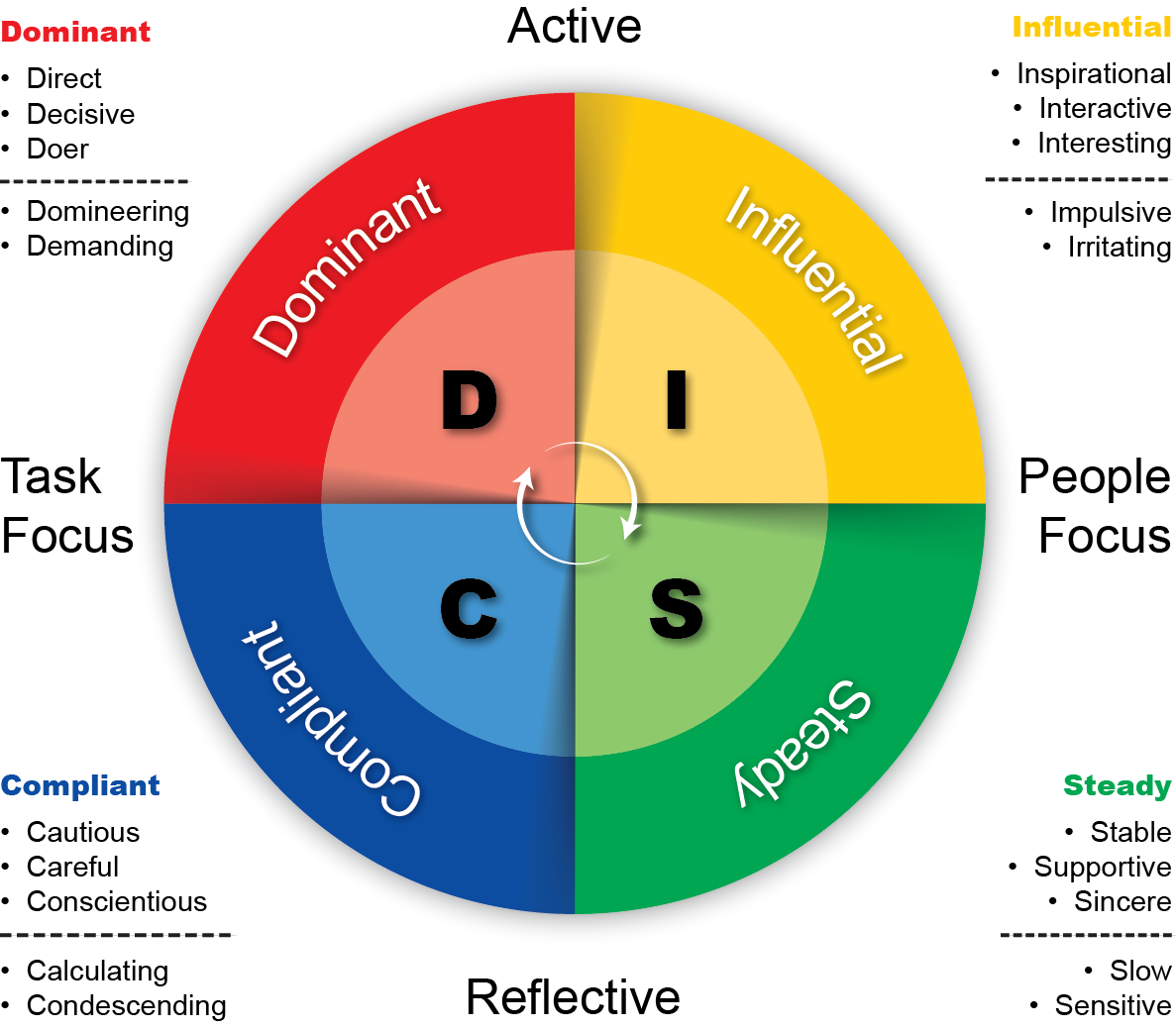
DISC profiles are essentially a behavioral assessment tool that help categorize people’s communication styles, decision making, and interaction preferences. Utilizing DISC tests can enhance L&D programs especially in the areas of team development workshops and facilitated team event sessions. These are occasions when employees come together, and by having a framework such as a DISC profile, it’s possible to give individual employees insight into their own strengths and weaknesses, as well as how they can better work with each other.
How Can DISC Profiles Enhance L&D Programs?
As stated, DISC tests can enhance L&D programs in the areas of team development workshops and similar team event sessions. Given that DISC profiles recognize four main styles—Dominance, Influence, Steadiness, and Compliance—having an understanding of your profile allows you to gain a better understanding of not only your own preferences for work and communication, but also that of those around you.
In summary, DISC would help you tailor the roles of individual employees in more detail, and allow people to leverage their own strengths in the roles they fulfill.
→ This type of insight is great for use as part of a personal development program, once more tying back into the five key components of a successful L&D program, as mentioned in a previous section.
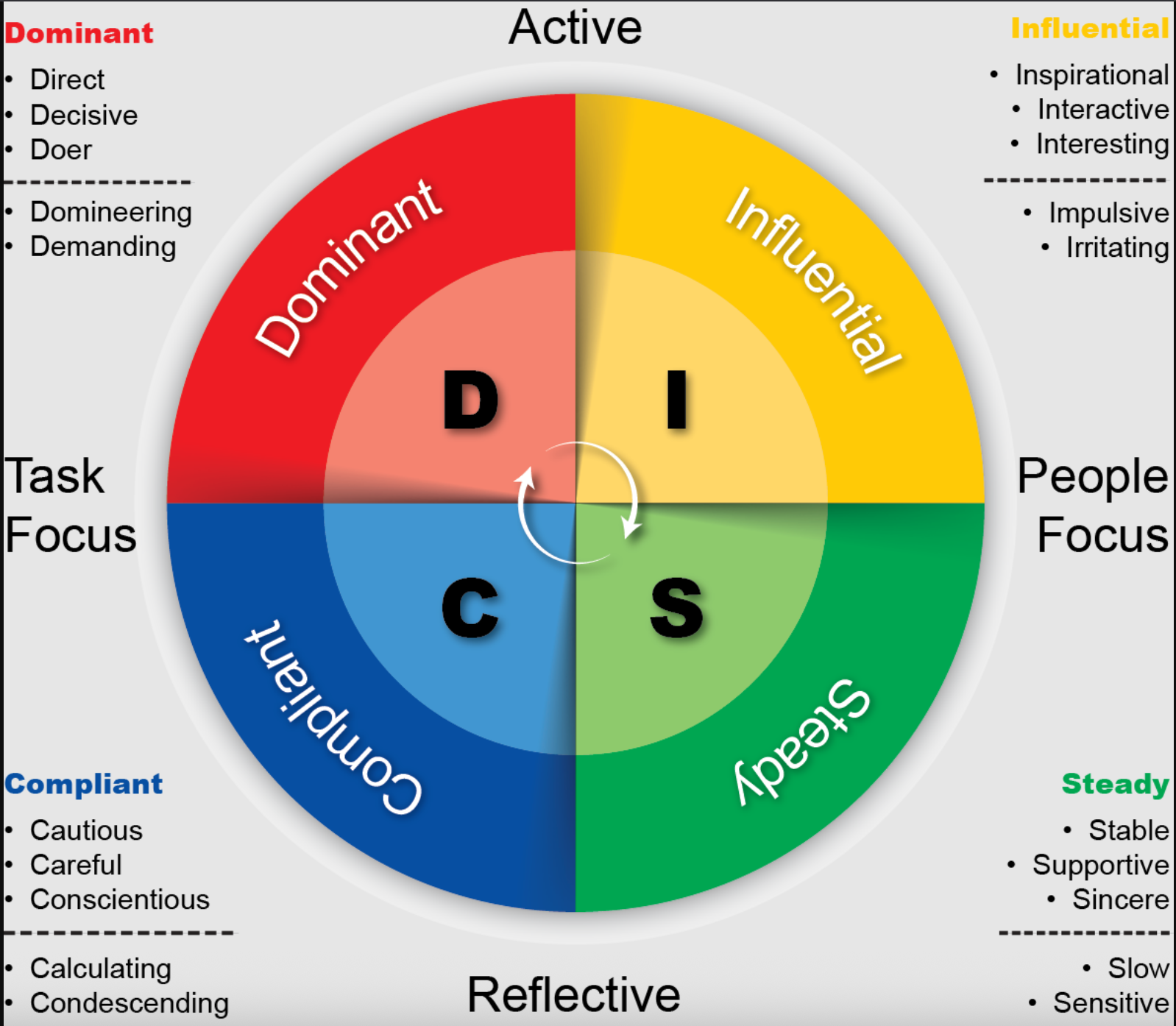
Image per John Pyron
What Are Some Examples Of DISC Insights Contributing To L&D Programs?
- Individuals high in the Dominance quadrant may benefit from leadership training that emphasizes decision-making and strategic thinking. This will also teach them the importance of teamwork and how to listen better, serving to quell their occasionally domineering personality type.
- Individuals high in the Influence quadrant may benefit from communication skills workshops where they can further improve on their natural communication abilities. These will also teach them to be less impulsive and impatient when it comes to decision making.
- Individuals high in the Compliance quadrant may benefit from analytical training and project management skills that require precision and care. Besides this, they can also learn to be more creative and free with their thinking.
- Individuals high in the Steadiness quadrant may benefit from team-building activities and supportive leadership programs. Furthermore, they can learn how to be better individual thinkers and understand how to be more assertive.
All in all, these are just a few examples of what’s possible once you have a grasp of where an individual sits on the DISC profile. No matter what, it’s important not to force someone way out of their zone as this can be too cumbersome. Instead, what you gain from using DISC in L&D programs is a better idea of what their strengths and weaknesses are from the get go.
A Case Study On L&D Programs Built With The Help Of DISC Profiles
I built an L&D program for an American construction company called Turner International based purely on DISC profiles. I did this by creating a full three-day program with DISC serving as the starting off point. This was done for senior engineers, senior HR leaders, and financial experts.
The reason DISC worked so effectively is because it provided insights for each individual as to their communication styles, decision making, and interaction preferences. Besides this, it also gave them useful information regarding how they interacted with others, which they could use moving forward. Essentially, from the jumping-off point that DISC provided, I could then begin creating activities, games, and roleplays tailored to their unique skill gaps and needs.
What I did at that point was use Lego© Serious Play© and models like the Johari Window to support creativity and create insight. At that point, it was possible to have participants engage in full scale games, building 3d objects, and generating real live situations where they needed to negotiate, handle pressure, and find solutions into a deadline based set of objectives.
In summary: DISC provided the fundamentals and the framework for the L&D program. From there it was possible to branch off in a variety of directions through workshops, facilitation sessions, and personal development programs.
How Can I Help?
With 20 years experience, including impactful roles at Google and Apple, I, Thijs van Loon, am here to help. My suite of services as a Skills Development Facilitator has been meticulously designed to propel your team to new heights.
One area of expertise is in Professional Skills Development, which can cover anything from sales training, team management, and building L&D programs.
By leveraging training certifications from Google and Apple, in addition to my certifications in NLP, Psych-K, DISC Flow, and LEGO© Serious Play©, I offer tailored, practical solutions that deliver immediate results to your business. By working together, I can help you empower the individuals in your company and your business at large, whether in Vietnam, Singapore or other locations in Southeast Asia.