
Figuring out how to implement what you’ve learned so that new knowledge is retained is just as much of a skill as being an effective learner itself. Despite such importance, many HR managers & business owners struggle to help their teams translate learning into meaningful action. Instead, they fall prey to a variety of pitfalls including having vague objectives, setting unrealistic expectations, and trying to learn too much at once. That’s why in order to effectively implement what you’ve learned, it’s crucial to develop active learning strategies. This means taking action, taking ownership of your learning, and valuing practice, among others.
Related: Read up on our Professional Skills Development services
What Does Implementing Your Learning Really Mean?
It becomes easier to grasp what’s meant by implementing your learning when you understand that learning can be split into two parts.
- The first part is the act of learning itself. There are many ways you can learn, and these can be categorized into passive learning and active learning strategies. More on each in a second.
- The second part has to do with what happens after the act of learning, namely, after knowledge is received. In this part, the theoretical knowledge received in part 1 must be applied in order to incite meaningful change.

What The Learning Pyramid Illustrates
Now let’s take a step back to what was mentioned about passive and active learning. Any time you’re learning something, you’re acquiring that information through a specific medium and method. Whether that be a textbook, a lecture, a video, a group discussion, all the way to the act of teaching others, there are numerous ways to learn.
The idea of the Learning Pyramid, developed by the National Training Laboratory, is that the medium and method you use to learn determines your overall learning experience, as well as how well that knowledge is retained. The image below illustrates it best.
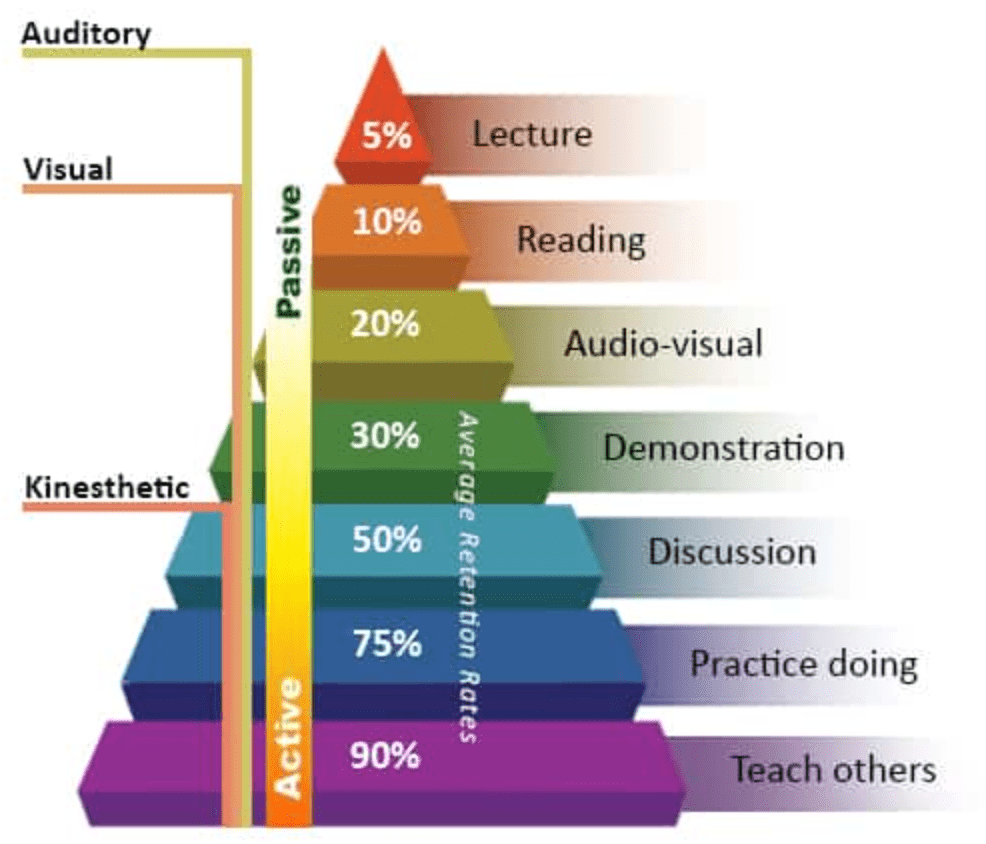
The Learning Pyramid per Education Corner
As you can see, the Learning Pyramid illustrates how more active, hands-on approaches to learning result in better overall learning experiences and knowledge retention. Understanding this is key moving forward.
Why Is Practice Crucial For True Learning?
So far, we’ve been referring to part 2 of learning as the act of implementing what you’ve learned. Another word for this is practice. Now, what makes practice so important for actual learning?
In essence, without practice, knowledge remains theoretical. Such knowledge can be considered useless, as it never actually translates into improved skills or behaviours. To give an analogy: imagine you’re learning how to swim. In an effort to do so, you read a book about swimming techniques and watch a few videos of people swimming. While you might have a better understanding of how to swim, you never put into practice any of what you learned in a pool. Can you now claim to know how to swim?
This analogy highlights the importance of practice. Learning itself, whether passive or active, is never enough. Application of that knowledge ensures it leads to improved skills and behaviours.
What Do You Risk By Avoiding Practice?
As mentioned, without practice, knowledge remains theoretical. Ultimately, this results in stagnation. While you might possess a certain degree of information, none of it ever makes any difference, creating what’s known as the knowing-doing gap. Popularized by Jeffrey Pfeffer and Robert Sutton, they highlighted the necessity of turning knowledge into performance.
The Link Between Action & Learning: Why Doing Matters More Than Knowing
For those confused about how to put what they know into practice, it’s important to start by taking action. This is because action is a mental commitment to personal development. Making such a deliberate decision fosters a growth mindset, encouraging you to embrace future challenges and reframe possible failures as learning opportunities.
Linking back to the swimming analogy, why not start by finding a local pool to practice? Better yet, how about finding a trainer to help you on your journey? What you’ll find by taking action is that it has a snowball effect. Small steps compound and help you reach that final goal of swimming.
On a separate note, taking action also promotes emotional engagement. The higher your emotional engagement, the higher your motivation. This is crucial as according to Team Stage, employees work 20% better when motivated. Regardless of if your motivation stems from finding a topic interesting or having a personal goal, it can boost engagement and effort in the learning process.
The 5 Biggest Mistakes That Prevent You From Turning Learning Into Action
Starting With Vague Objectives
An all too common but detrimental pitfall that prevents you from turning learning into action is starting with a vague objective. Such a lack of specificity and measurable outcomes prevents you from properly formulating a roadmap into how to achieve said objective. This makes the whole process needlessly confusing and as a result, ineffective.
→ Instead of that, define precise objectives by identifying specific scenarios and skills. Rather than aiming to simply, ‘negotiate better’, try practicing active listening and empathy in an upcoming negotiation with your supervisor when discussing vacation time.
Setting Unrealistic Expectations
Even if you set a specific objective, if you’re setting an unrealistic expectation at the same time, that can also lead to its own host of problems. Unrealistic expectations can be anything from a goal that’s too lofty to an unrealistic time frame to achieve said goal.
→ Instead of that, acknowledge that goals take time. You may also have to set proper habits in order to achieve those goals, and habits take time, too. According to James Clear, it takes more than 2 months before a new behavior becomes automatic — 66 days to be exact.
Falling Victim To The ‘One And Done’ Mentality
When some people think of effort, they think of the minimum amount of effort required. Without sufficient progress made after one attempt, they give up. The reality is, a single training session is never sufficient for mastery, and can impede skill development.
→ Instead of that, it’s crucial to engage in continuous practice sessions to ensure skills and knowledge are constantly revisited and polished.
Attempting To Learn Too Much At Once
A distant cousin to the one and done mentality is the everything all at once mentality. While it’s tempting to try to achieve mastery over something as soon as possible, effective learning and practice take time.
→ Instead of that, break down a single skill into multiple components and focus on one aspect at a time. For example, when improving negotiation skills, start by practicing active listening before progressing to other techniques.
Lacking A Clear Training Strategy
A training strategy provides a structured plan for taking action and gaining a deeper understanding of existing knowledge and skills. Without one, learning and practicing lack any real direction, making the whole process ineffective.
→ Instead of that, develop a clear training strategy that includes specific goals, timelines, and evaluation methods. From there, tailor the plan to address individual learning needs that align with desired outcomes.
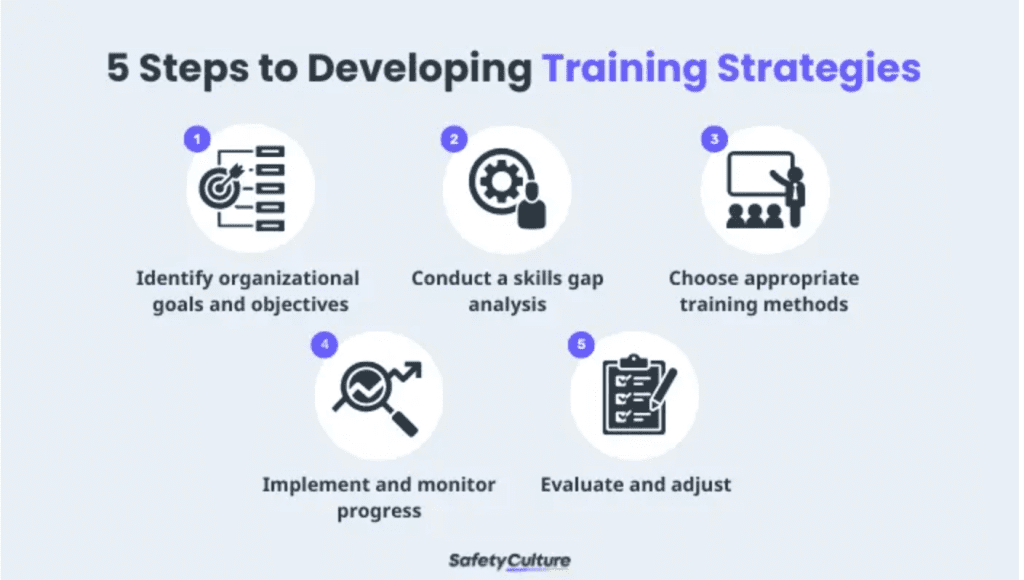
A 5 Step Process For Developing Training Strategy, as per Safety Culture
Implementing What You Learn: 5 Expert Tips for Lasting Skill Development
Take Ownership Of Your Learning
Taking ownership of your learning is a critical part of getting better at implementing what you learn. There are a variety of reasons for this, but what it comes down to is personal responsibility. By actively choosing to learn rather than passively waiting for learning to happen, you’re much more likely to actually do what you set out to. According to Docebo, this is known as intrinsic motivation, which is the motivation to do something by the pure joy it brings.
Select Learning Topics Based On Personal Interest
Piggybacking off the previous idea, it’s much easier to take ownership of learning when you’re choosing topics that genuinely interest you. It’s not hard to see why. Any time you’re learning something you’re passionate about, learning becomes that much more enjoyable–All of a sudden it no longer feels like a task! While you won’t always be able to pick and choose your favourite learning topics, if you get the chance, always go for what you love.
Anticipate & Embrace Setbacks
The process of learning is a road riddled with setbacks. This is why it’s much better to anticipate and embrace those setbacks, as by doing so, when they occur they won’t have as negative an effect. This type of mindset builds perseverance, resilience, and adaptability. Furthermore, true learning comes from dealing with and overcoming setbacks. They are a natural and crucial element for learning.
Monitor & Reflect on Progress
When you monitor and reflect on progress made so far, you’re once more taking ownership of your learning and committing to making the most out of it. On top of this, regularly tracking personal development allows for constant adjustments, which can reinforce learning over time. This can provide motivation too.
Incorporate Movement Into Learning
Returning to the swimming analogy, incorporating movement into learning refers to actively putting your learning in place. Without proper immersion in a skill, you’ll never develop the requisite tools needed to coherently understand it. Whether it’s swimming, cooking, or negotiating, you’ve got to incorporate movement into your learning.
Southeast Asia vs. Europe: The Cultural Impact on Learning & Skill Development
There’s no question that cultural differences in learning styles affect how people teach. As someone who’s had working experience in both the West (Europe) and the East (Southeast Asia), I understand the subtleties that make up each region and why it’s necessary to have an understanding of their differences. To illustrate these, here’s a table.
| Factor | Southeast Asia | Europe |
| Hierarchy | Southeast Asian education and culture in general prioritizes an absolute respect for authority. This leaves little room open for questioning. | In contrast, while hierarchies exist in Europe, they aren’t as stringent as they are in Asia. This leaves some room open for questioning. |
| Learning style | Southeast Asian learning styles are much more centered around structured learning sessions. Clear frameworks, step-by-step instructions, and instructor led-guidance is important. An emphasis is also placed on memorization of material. | In contrast, Europe prefers a more independent, debate-driven, and exploratory learning style. Open discussions, critical thinking exercises, and self-directed problem solving are important. |
| Questioning | Southeast Asian learners, due to their respect for hierarchy, are less likely to challenge or question teachers about concepts and lessons.This is why small group discussions that facilitate questioning are so vital. | In contrast, European learners are much more comfortable with directly challenging teachers about concepts and lessons. This can lead to open ended discussions, which are commonplace when learning in Western style classrooms. |
As always, the best way for teachers to ensure that students get the most out of any learning session is to have an understanding of their group’s learning preferences and tailor sessions to meet those demands. In the case of more global, international audiences, having a balance between the two will ensure that each group’s needs are met, while challenging them enough to step out of their comfort zone.
On a final note, the ultimate goal with any kind of learning is to have students take ownership of their learning. A good teacher or mentor should not only provide initial guidance but also help develop skills for this. Over time, this shift allows learners to take ownership of their personal development, creating proactive, self-driven learners that are capable of adapting and exploring new areas of expertise on their own.
Negotiations can make or break your business: Learn more about The Art of Workplace Negotiation
Pizza 4Ps: A Case Study In Making Learning Stick
One of Vietnam’s most beloved restaurant chains, Pizza 4Ps needed help figuring out how to ensure its culture of compassion, kaizen, authenticity, and omotenashi (Japanese hospitality) would remain intact while the company expanded. Doing so is possible so long as employees and managers learn the right behaviours in training sessions. Teaching them how to run those training sessions was where I came in.
- The first step involved running a training needs analysis as well as interviewing key individuals in Pizza 4Ps. These provided a deeper understanding of what skills and practices they valued in their company culture.
- These skills and practices were then made into training content that the central management team, restaurant managers, and area managers could use to ensure culture was passed on. It was important that content was conceptual as well as practical in day to day operations.
- From there we could workshop the training content. Two recap sessions occurred during every workshop: one after the session to ensure knowledge retention and another at the start of every workshop to recap the last session’s content.
- At this point we could start building personal development plans (PDPs) that helped track learning and made sure it aligned with what employees actually did at work.
- From there we started coaching. This involved hiring a coaching company to run sessions for the high level leaders to implement what they put into their PDPs, as well as making sure we could tailor support for learners.
- Finally, we ran 360 reviews to measure whether the skills and practices defined in step 1 were met. This allowed for a comprehensive analysis of the whole process.
How Can I Help?
With 20 years experience, including impactful roles at Google and Apple, I, Thijs van Loon, am here to help. My suite of services as a Skills Development Facilitator has been meticulously designed to propel your team to new heights.
One area of expertise is in Professional Skills Development, which can cover anything from sales training, team management, and learning how to practice lifelong learning.
By leveraging training certifications from Google and Apple, in addition to my certifications in NLP, Psych-K, DISC Flow, and LEGO© Serious Play©, I offer tailored, practical solutions that deliver immediate results to your business. By working together, I can help you empower the individuals in your company and your business at large, whether in Vietnam, Singapore or other locations in Southeast Asia.