

While you might consider negotiation a skill that only salespeople need to know, the reality is, so much of life in the workplace centers around negotiation. Whether you’re asking for a raise, resolving a conflict, or figuring out how to work with a different team, negotiating happens on a daily basis! In this article, you’ll learn about the art of workplace negotiation, and why traits like emotional intelligence, adaptability, and patience, among others, are so important for effective negotiation.
Negotiation 101: What Is It?
Negotiation is a process by which two or more parties engage to resolve differences and reach a mutually acceptable agreement. What separates good from bad negotiation is that effective negotiation seeks solutions that satisfy the needs of all parties to their utmost degree, rather than settling for any kind of compromise. This type of negotiation focuses on long-term solutions and maintaining open communication, thereby creating a culture of connection and cooperation.
Related: Read up on our Professional Skills Development services
Negotiation Beyond Deal-Making: 3 Key Areas
As mentioned, negotiation goes beyond sales and the art of the deal. This is precisely why having negotiation skills are so important: they affect every facet of your life. Let’s learn about the 3 key areas where negotiations play a crucial role.

Everyday Interactions
Whether you’d like to believe it or not, the majority of our everyday interactions are rooted in some form of negotiation. Whether this be discussions with your family regarding potential summertime travel destinations, chats with a partner about where to go for dinner that evening, or small talk at a party with a stranger you’ve never met.
Small instances of negotiation are peppered throughout our daily interactions, making it one of the most pervasive forms of social communication.
Workplace Dynamics
Negotiations constantly happen in the workplace. Whether this be in the form of job interviews, talks with your boss, or figuring out how to deal with difficult colleagues, negotiations play a vital role in shaping workplace dynamics. By understanding this and developing your own negotiation skills, working becomes that much more productive, fun, and satisfying.
Community & Social Settings
Lastly, in community organizations or social groups, negotiation is essential for planning events, allocating resources, and establishing group norms. These are situations in which groups of people are involved in deciding what’s best, meaning negotiations occur on a much larger scale than they would when dealing with friends, family members, or a team at work. Understanding negotiations on this scale allow you to foster inclusivity, cooperation, and learn to work with a variety of different viewpoints.
How Do Negotiation Skills Benefit Each Area?
| Everyday Interactions | Workplace | Community/Social Settings |
| Better conflict resolution between friends, family, and service providers. | Better understanding of negotiating promotions, salaries, and professional development opportunities. As per ScotWork, 87% of young professionals who negotiate their salary, got at least some of what they asked for! | Ability to foster inclusivity thanks to large scale negotiation skills. |
| Improved communication allows you to better express yourself and listen to others. | Better conflict management and ability to collaborate effectively. | Better chances of getting policies passed in local groups and communities. |
| Helps build stronger relationships between people, whether strangers or family. | Improved leadership skills, with deeper understanding of settling disputes and motivating teams. | Better group cooperation across different beliefs, viewpoints, and cultures is easier. |
→ Understanding the prevalence of negotiation throughout all aspects of your life helps underscore its value and importance. Moving on, let’s begin taking a look at what you can do to improve your negotiation skills.
The Importance Of Listening In Negotiations
When you hear the word negotiation, you might imagine a sweet-talking salesperson who knows what the other person wants to hear in order to close a deal. While the importance of verbal communication cannot be understated, an aspect that often gets overlooked when it comes to negotiation is the act of listening. Listening is a vital part of negotiation. However, within listening itself are a number of different forms, with some being more effective than others. I like to use Stephen Covey’s 5 Level Listening Framework as a means of explaining the differences in each. Let’s take a look at each and the role they play in your negotiation skills.
Ignoring
Ignoring is the lowest and weakest form of listening. Really, it’s hard to categorize it as listening in the first place, as when you ignore the speaker you’re not actually paying attention to any of what they’re saying. Reasons for ignoring vary. Whether it stems from utter indifference or if you’ve simply got a few other things on your mind, the effect is the same: you don’t hear what the other person is saying and they don’t feel as if they’re being listened to.
→ Ignoring is no way to improve your negotiation skills. It’s the enemy of effective negotiation and is a selfish means of non-communication.
Pretend Listening
Just as bad as ignoring but masked to look prettier, pretend listening occurs when you simply don’t care what the other person is saying. While you might be looking at whoever’s talking, and while you might nod and provide a few verbal affirmations, in reality, none of what they’re saying is entering your mind.
→ Pretend listening also ruins your chances of becoming a better negotiator. While it might feel like a step up from ignoring, the outcome is no different.
Selective Listening
As the name suggests, selective listening is all about hearing what you want to hear. Most of us tend to selectively listen when we’re arguing or negotiating with another person. The reason for this is that we want to believe the conversation is going in the direction we want, so we latch onto the parts that make it feel like it is.
→ Selective listening might make you feel as if negotiations are going your way, but in reality, you’re not getting the full picture. This isn’t conducive to promoting open, communicative relationships with others.
Attentive Listening
Now we start getting to a point where you’re fully engaged and listening. Attentive listening showcases your connection to a conversation, with the right body language, right questions, and right responses.
→ Attentive listening promotes healthy negotiations, whether asking for a raise, talking to a spouse, or figuring out how to work with a colleague you don’t see eye to eye with.
Empathetic Listening
Even deeper than attentive listening is empathetic listening. This is where you’re fully engaged in a conversation but you also try to listen for understanding–Essentially, it’s the act of trying to put yourself in the other person’s shoes, and to grasp the why behind their words.
→ Empathetic listening makes you a master negotiator. In this stage, you’re doing more listening than talking, which makes the other person feel heard and as a result, opens a pathway for open, cooperative communication. This matters in the workplace as, according to Words Rated, being able to actively listen (attentive/empathetic listening) is shown to increase productivity and collaboration by up to 25%!
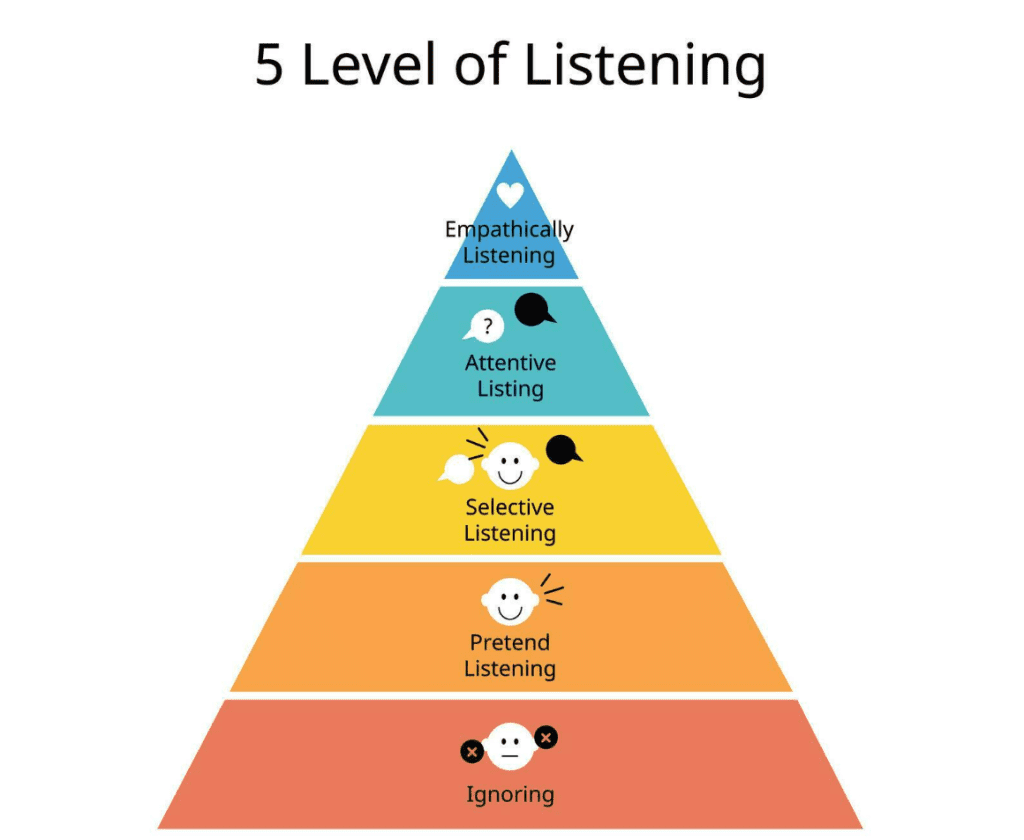
5 Levels of Listening as per Vecteezy
How Can I Help You Become A Better Listener?
Whenever you attend one of my workshops, part of my aim is to help you become a better listener. I do this by helping you learn to quiet the voices in your head, which allows you to listen more attentively so you can focus on what’s actually being said. As per statistics on Healthy Place, the normal, untrained listener is likely to understand and retain only about 50% of a conversation. Learning how to listen can help bump those numbers up!
Beyond listening, however, to become an effective negotiator you also need to learn how to extract information from others. In order to do this, I rely on techniques like mirroring™, which I learned from Chris Voss’s book, Never Split The Difference.
- What’s Mirroring™?
Mirroring refers to repeating one to three words of what another person said after they’ve finished speaking. Usually, this can be the last one to three words, but once you get good at the skill you can pluck a few words from anywhere in the other person’s conversation. What this does is makes the other person feel heard, creating connection and trust which are integral for smooth negotiations.
Top 7 Skills That Can Transform Managers & Employees Into Effective Negotiators
Emotional Intelligence
Your capacity to recognise your own emotions, manage them, while empathizing with others can make or break your ability to navigate the complex dynamics of negotiations. Really, the importance of emotional intelligence goes beyond negotiation, with findings posted on Soocial stating that EQ (emotional quotient) is four times more effective than IQ in determining who will be successful in their field.
Effective Communication
While it might be the most obvious trait that can benefit your negotiation skills, effective communication goes beyond being able to talk well. As mentioned, the importance of listening plays a key–perhaps even greater–role than talking when it comes to getting what you want out of negotiations.
Preparation & Planning
Regardless of what type of negotiation you’re entering into, preparing and planning in advance is the way to maximize your chances of coming out with what you want. This can involve understanding both your objectives and the interests of the other party so that you can go into said negotiation with an idea of common ground and potential trade-offs.
Adaptability
Rigidity is the enemy when it comes to smooth negotiations. By adopting a flexible, adaptable mindset, it becomes possible to respond to real-time changes without slipping up or making any faux paus. Furthermore, being open to alternative solutions and creative problem-solving enhances the likelihood of reaching a satisfactory agreement–This helps in all areas of work, with 60% of employers believing that adaptability has become more important this decade than in the past, according to research on Horton International.
Questioning & Clarification
Understanding how to ask the right questions during negotiations can allow you to uncover deeper insights into what the other party is looking for and where they draw the line. Using techniques like mirroring to summarise their points also help build trust and make it easier to reach agreements that benefit both parties.
Patience & Composure
Negotiations can take time. There’s nothing worse than losing patience and composure while trying to reach a deal, as this can destroy any chance of you reaching a favorable outcome. Practice mindfulness throughout these procedures and understand that thoughtful negotiations are better than hasty ones.
Trustworthiness
Trust is the foundation of all good negotiations. You’d be surprised to find that more so than being a great negotiator, demonstrating openness and honesty can lead you to landing a deal more so than sweet talking ever could.
What Are The 3 Most Common Negotiation Styles?
| Analysts | Accommodators | Assertives |
| Detail oriented. Need facts and figures to back things up. Closely monitor what they give in exchange for what they receive. | Relationships are everything. Love saying ‘yes’ and making sure all parties involved are happy. Great at building connections and getting people to like them. | Love to win. Negotiations are a battle and if you give them an inch, they’ll take a mile. They can often be abrasive, pushy, and demanding. |
| Can be too much in their own head and focused on numbers rather than building relationships with others. | While they’re good at saying ‘yes’, they sometimes lack the ability to get things done once the deal is done. They also have a tendency to over promise. | While they think they’re good at getting their way, this is their downfall as no one wants to negotiate with assertives. |
→ Depending on where you look, there are a range of negotiation styles. I like to focus on these 3, which I got from Never Split The Difference, as it simplifies the idea into digestible pieces.
Time management is key to getting the most out of your day: Read up on Everything You Need To Know About Time Management
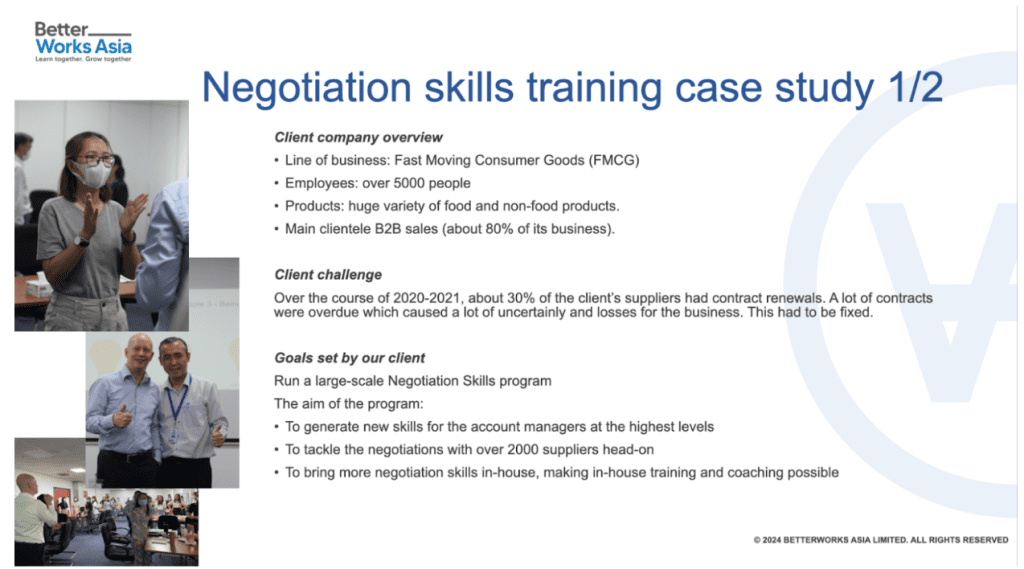
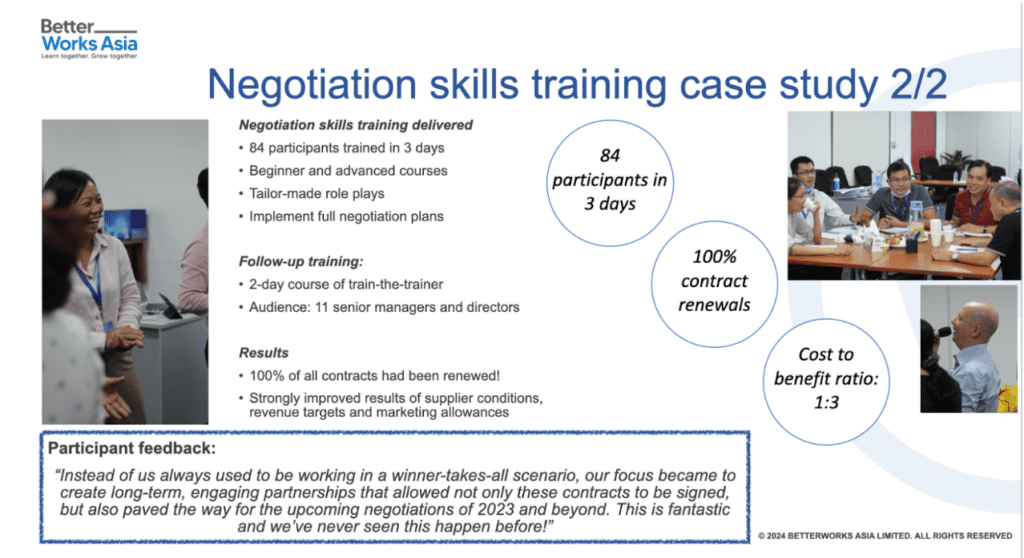
Training Negotiation Skills: A Case Study
How Can I Help?
With 20 years experience, including impactful roles at Google and Apple, I, Thijs van Loon, am here to help. My suite of services as a Skills Development Facilitator has been meticulously designed to propel your team to new heights.
One area of expertise is in Professional Skills Development, which can cover anything from sales training, team management, and improving negotiation skills.
By leveraging training certifications from Google and Apple, in addition to my certifications in NLP, Psych-K, DISC Flow, and LEGO© Serious Play©, I offer tailored, practical solutions that deliver immediate results to your business. By working together, I can help you empower the individuals in your company and your business at large, whether in Vietnam, Singapore or other locations in Southeast Asia.