

As a business leader, leadership and development programs (L&D) are one of the best ways to ensure that your employees are motivated, effective, and happy while they work. According to Gitnux, 74% of employees say they’re willing to learn new skills to stay relevant in the workplace. L&D programs make this possible by teaching an array of vital skills. However, there’s often an issue with how these skills are taught. Enter LEGO® Serious Play® (LSP), a form of learning that uses LEGO blocks.
Key Takeaways
- Current L&D programs fall short of providing meaningful change. From facilitation and delivery issues, to a lack of proper follow up and support, the current state of L&D is lacking in substance. Understanding this is step one in ensuring L&D can actually help learners develop and grow.
- When combined with LEGO® Serious Play®, L&D programs are taken to the next level. LSP is a means of improving employee engagement and retention, promoting freedom of expression, and it can be combined with other training theories. This makes it a holistic learning methodology with numerous benefits.

The 5 Pillars Of A Successful L&D Program
I always consider three aspects to ensure an L&D program is as good as it can be: alignment, clarity, and real-world application. Essentially, are learners getting the skills they need, when they need it, and can they apply those skills once training is over? In order to make sure these boxes are ticked, I like to think about the 5 pillars of a successful L&D program.
1. Start With A Rock Solid Training Needs Analysis
While stats posted on sites like Research will tell you what the most in-demand skills are in today’s economy—Interpersonal Skills (85%), Written and Spoken Communication (85%), and Critical Thinking Skills (84%)—the fact remains that you cannot simply rely on these numbers when figuring out what to upskill.
Every effective L&D program begins with an understanding of what people actually need to learn, which means conducting a training needs analysis to figure that out. These are designed to determine the gap between what a company needs and its employees current skill level by asking a variety of questions and gathering input from all the individuals in a team. Whenever I conduct one myself, it always gives me a much better idea of what to do moving forward, ensuring I’m providing training that is matched to the needs of the trainees.
2. Ensure Shared Ownership Of Learning Goals
While an L&D program might feel like the responsibility of a HR team, solely relying on them can often be to your detriment. By involving all stakeholders—staff, management, executives—from day one, you’re ensuring a much more hands-on and personalized approach. There are numerous benefits for this, one the fact that 79% of workers report that they would participate in training programs if they were personalized to their interests and needs, as per World Metrics.
3. Make The Needs & Insights Visible
Transparency is everything with L&D programs. This means that even during the training needs analysis phase you’re going to want to prioritize being as open and honest as possible. Sharing information across departments creates a culture of community and company-wide improvement, giving a sense that everyone’s sailing in the same boat.
4. Link Training To Strategy & Timing
A great L&D program doesn’t simply react to problems as they pop up—It anticipates potential issues and futureproofs teams in the event they occur. It’s imperative that companies understand this concept by aligning the strategy of your team and company with timely and tailored training programs. Doing this ensures people get the training and skills at the time they’re needed.
5. Evaluate Impact, Not Just Satisfaction
Most organizations are happy enough to evaluate L&D programs based on how satisfied their employees were. While this is a step in the right direction, it’s nowhere near enough. I recommend the Kirkpatrick Model to evaluate learning on four levels.
- Reaction: Did they enjoy it?
- Learning: Did they gain knowledge or skills?
- Behavior: Are they applying it on the job?
- Results: Is there a measurable business impact?
A model such as this provides a much better framework for getting a holistic view of a program’s efficacy. Beyond this, you can include other tools to make the evaluation more robust. Let’s say you train a sales team. As a means of evaluation you can record sales results and even have ‘mystery shoppers’ visit to evaluate teams on specific, trained elements. Ultimately, this can be customized to your heart’s content!
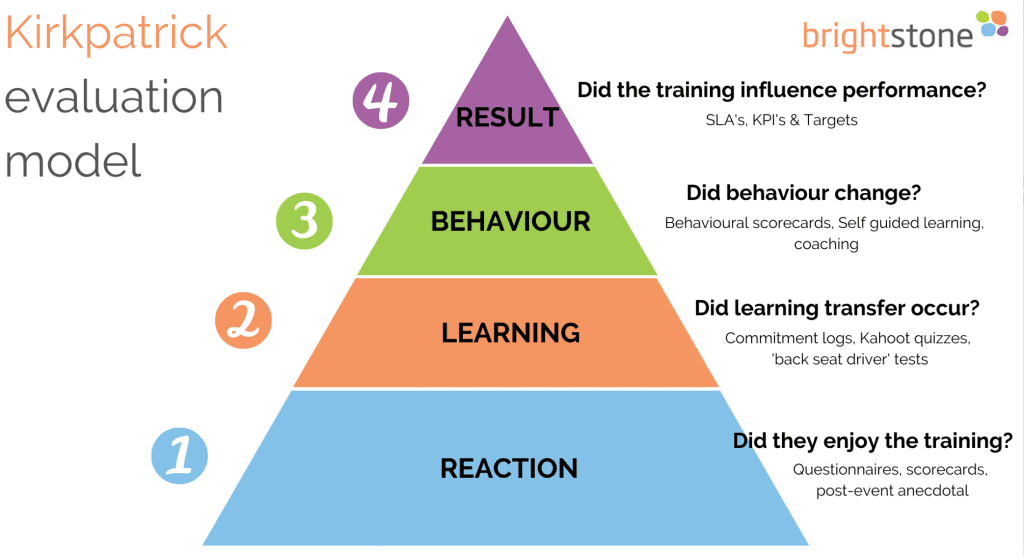
Image courtesy of Brightstone
Related: Read up on our Professional Skills Development services
What Are Common Pitfalls When Delivering L&D Programs?
There are numerous pitfalls that occur when delivering L&D programs. Besides not doing what I mentioned in the previous section, here are some of the most common that I’ve seen over my two decades’ worth of experience as a skills development facilitator.
Logistic & Environmental Issues
- Running the program in your own office (too many distractions, interruptions).
- Not allowing people to focus on the program.
- Not making training part of work, and so running the program during a weekend which makes participants less likely to want to attend.
Facilitation & Delivery Issues
- Failing to use an experienced facilitator to run the program.
- Creating too large of a group for training delivery (overloading the facilitator and reducing impact on participants) → Groups of 7 to 15 are the best!
Follow Up & Support Issues
- Not having any follow-up after the training.
- Not using proper evaluation measures after training (sticking to one-dimensional, satisfaction based questionnaires).
- Not supporting people during and after the program (not having regular intra and post training conversations → 1-1 discussions with managers are never a waste of time!)
- Not thinking about success in terms of long-term goals. Only focusing on the short-term.
Mindset & Strategic Issues
- Seeing training as a checkbox exercise (believing you only need to “tick the boxes” in order to see real growth through training).
- Treating training as an isolated event rather than part of continuous development.
- Not allowing participants the space to ask questions and take ownership of their learning.
The A-Z On LEGO® Serious Play®: How Does It Influence Training Implementation & Retention?
LEGO® Serious Play® (LSP) is a form of learning and communication technology that leverages LEGO blocks to promote 3-D thinking and sense making in a way that accesses parts of our brain that are normally hidden. With LSP, LEGO is used as an integral tool in the process of learning, rather than the focus of the process itself. Coupled with the memories and playful ideology surrounding LEGO, this makes for a powerful tool to unlock answers to a variety of questions.
How Are LEGO® Serious Play® Sessions Structured?
LSP sessions are typically structured in a 4-step process.
- Question
During this step, participants are presented with a question. These can be about any number of topics. For example, a facilitator might ask: ‘What does success look like for your team/company?’, or, ‘What does my ideal role look like in this organization?’.
- Build
During the build, participants are given a set of LEGO blocks and some time to build out their answer to the question. Participants tend to do this on their own, as the idea is to come up with your personal, unique response to the question.
- Share
At this point, participants will come together to review and share the meaning and idea behind their creation. Every participant is given the space to talk, which is why smaller groups are better as they ensure everyone is given some time to express themselves.
- Summarize
Lastly, participants will get to summarize their LEGO creation. This is usually done by writing a short sentence on a piece of paper about what their LEGO means to them. Next steps will be discussed.
→ While this 4-step structure always remains the same, the level of depth and complexity can differ based on the question and challenges posed. This elevates LSP to something beyond a mere training method into a fully fledged facilitation system that allows participants to access their subconscious and come up with ideas, solutions, and insights that only they can think of.
Why Is LEGO® Serious Play® Effective In L&D Programs?
Flexible Application
LSP is effective because it can be applied during any stage of an L&D program. This means that whether you’re still going through a training needs analysis or you’re evaluating the impact of an L&D program, LSP allows you to ideate solutions during these various stages.
A Fun Way To Boost Engagement & Retention
As per research posted on Thriving Teams Institute, when learning is enjoyable, retention rates can increase by up to 60%! Here lies another of LSP’s benefits during L&D programs—Larning becomes that much funner as you’re being creative rather than simply sitting in a room listening to a Powerpoint presentation.
Combines With Other Training Theories
Besides this, LSP is also great when used in combination with other training theories. Examples of programs you can use LSP with are the Johari Window, The Business Canvass, The 5 Forces Model, or in cultural programs like Riders & Elephants. Let’s consider how this might work with the Johari Window, which is a model that’s designed to improve self-awareness and mutual understanding amongst people in a group.
You can merge LSP with the Johari Window by asking team members to build models representing each other’s strengths and weaknesses. Doing so can reveal perceptions that might otherwise be unknown to a member. This can bring the team closer while offering insights about how each member is perceived.
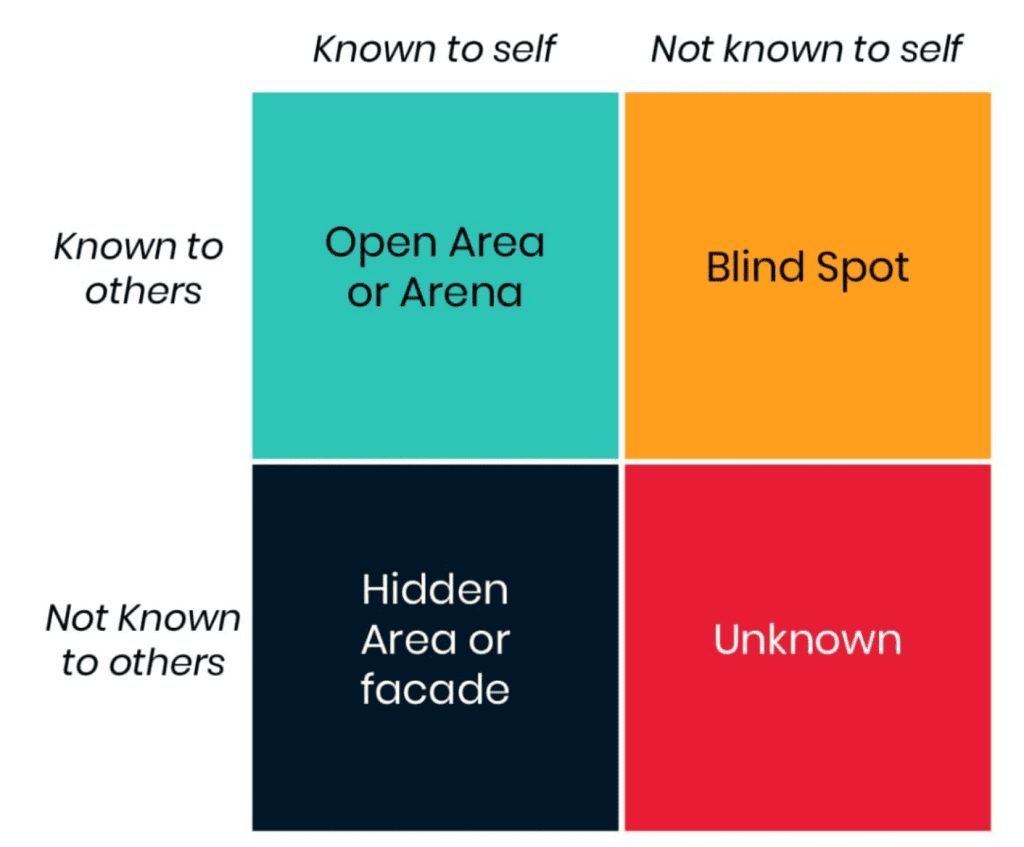
Image courtesy of The Mind Fool
Promotes Freedom Of Expression
Finally, the efficacy of LSP with L&D programs lies in its ability to promote freedom of expression. As a trainer, I’ve come across many groups where a few vocal members dominate the discussion and appear to hold the most weight over the group’s decisions. However, this doesn’t happen with LSP. As a system LSP has a need to let everyone share their thoughts. This way, all feel appreciated, heard and, ultimately, part of the group. This makes it one of the most democratic facilitation systems out there.
Interested in learning how to build L&D programs? Read up on Building L&D Programs For The Southeast Asian Workforce
How Do You Design An L&D Program That Includes LEGO® Serious Play®?
In order to best grasp how LSP can fit into an L&D program, I’d recommend attending my training sessions to learn the finer points. However, as a general overview, it’s important to realize the need to break down the skills trainees need to learn into bite-sized pieces that are digestible and timely.
The key is to do these break downs in a way that trainees feel involved, challenged, and empowered throughout the whole process. LSP helps because it asks trainees questions along the way to help them retain the knowledge, experiences, and behaviours they learned. Despite this, it’s important to recognize when LSP isn’t needed during an L&D program. The point is to know when creativity, ideation, and systems thinking are required, which is when LSP can play a pivotal role. Otherwise, you don’t need to see LSP as the hammer with which you hit every nail in sight.
What Trends Are Shaping The Future & How Does LSP Fit In?
Thanks to artificial intelligence, training programs are becoming that much easier to produce. This is a double edged sword as it democratizes content building but in doing so, means that the quality of content often falters. The reality is, you need skilled facilitators to effectively put programs into place. Creating content for an L&D program is one thing, making sure it runs smoothly is an entirely different prospect.
This is why it’s my firm belief that though AI is already helping with the production of content, you will always need skilled facilitators to run L&D and LSP programs. Furthermore, the digitization of training through AI may be convenient but it’s necessary to ensure humans can connect with each other with in-person training sessions. LSP requires this in-person aspect in order to work effectively which is why it’s a future-proof system of learning and development.
Using LEGO® Serious Play® to Shape & Support An L&D Journey
A case study I like to reference that showcases how LSP helps with L&D was a program I built for Marou Chocolate. The objective was clear from the get-go: develop the leadership capabilities of over 40 middle managers. To ensure focus and depth, we divided the group in two and designed a training journey made up of four full-day workshops. The core topics included:
- Leadership & Management Fundamentals
- Communication Skills & Dealing with Conflict
- Delegation Skills
- Coaching as a Manager
Here’s how LSP played a role throughout the program.
- Breaking The Ice
Starting with an LSP warmup, we were able to explore a variety of topics as well as dive into every participant’s personal understanding of leadership. This set the tone for the rest of the four days, fostering an open, non-judgemental environment.
- Midway Reflection
As the program progressed, it was vital to use LSP to ensure trainees were retaining information. This helped turn abstract concepts into actual memory that trainees could recall even once the program ended.
- Delegation Mapping
Using LSP, we were able to visually identify the strengths and weaknesses of each team member, making it that much easier to figure out who should be delegated what and why.
- Final Reflection
As always, no LSP program is effective without a final reflection. In this case we closed the program by having participants build models to show where they started, where they are now, and where they see themselves going in their leadership development journey.
What Should You Do Next?
Despite all the details I’ve provided about L&D programs and how LEGO® Serious Play® can help foreign companies operating in Asia, you still might be a little confused as to how to proceed.
If that sounds like you, don’t hesitate to contact me now! As someone with over 20 years experience as a Skills Development Facilitator and roles in Google, Apple, and beyond, I’d love to help you out with any issues you might face along your journey of improvement.